Originally Published as: Beyond the Barn: A Builder’s Guide to Winning Municipal Building Projects
Fire stations, public works garages, community centers and civic venues are being built in the same counties and along the same highways as the ag buildings and pole barns this magazine has always covered. Two Minnesota projects — a new fire station in Otsego and a riverfront amphitheater in north Minneapolis — offer a real-world look at how municipal work gets funded, bid and built, and what a contractor or supplier needs to do to get a seat at the table.
A Bigger Tent for Rural Builder Readers
For years, this magazine’s coverage has centered on post-frame and metal-frame agricultural buildings — and that work isn’t going anywhere. But the contractors, component manufacturers and suppliers who serve rural and small-town America are increasingly working on a different kind of project: municipal buildings. Fire and EMS stations, public works garages, water treatment facilities, community centers, park pavilions and performing arts venues are being built in the same counties and along the same highways as the projects this magazine has always covered, and many of them draw on hybrid construction methods that blend post-frame, steel-frame and conventional techniques.

This issue takes a different approach to a project focus feature. Rather than simply profiling two finished buildings, we’re using them as a jumping-off point for something more useful to a reader weighing whether to chase this kind of work: a practical look at how municipal projects get funded, how they get bid, and what it actually takes for a builder who has never worked with a city council or a construction manager to land a contract like this one. Along the way, we point to the public sources that make that research possible and to the manufacturers whose siding, roofing, door and skylighting products show up on this kind of building. Both lists appear at the end of the article.
Municipal work looks different from a typical ag building job. Projects are usually bid rather than negotiated, funded through bonds, levies or a mix of state and federal grants, and subject to a longer list of code, accessibility and life-safety requirements than a farm shop. But the underlying construction economy — metal panels, structural steel, insulated systems, doors and hardware built for heavy daily use — overlaps heavily with the products and services already advertised and exhibited across Shield Wall Media’s publications and shows. For builders looking to diversify, municipal buildings are a growth lane worth understanding, and one this magazine intends to cover more of going forward.
Why Municipal Work Is Worth a Second Look
Municipal construction has a few characteristics that make it attractive to a contractor looking to smooth out the peaks and valleys of a purely agricultural or residential book of business.
Budgets are public record. Bond issues, capital improvement plans and levy increases are discussed in open council meetings and published well before a project goes out to bid, giving a contractor months or years of advance notice.
Payment is reliable. Public owners don’t disappear, and payment and performance bonds protect subcontractors and suppliers up the chain in ways a private residential job often can’t.
The work is recurring. A city that builds one fire station, public works facility or park building will build another. Once you’re a known, qualified vendor, subsequent bids get easier.
It diversifies revenue. Municipal budgets run on a different cycle than agricultural spending, which can help offset a slow year in the ag economy with public-sector work that isn’t tied to commodity prices.
None of that makes municipal work easy. It comes with more paperwork, more inspection, and a bidding process with real legal teeth. The rest of this article is meant to walk a first-time or occasional municipal bidder through that process, using two very different current Minnesota projects as illustrations of how the money, the design team and the construction contract actually come together.
How Municipal Projects Get Funded
Understanding where the money comes from is the first step to knowing when and how to position your company for a bid. Most municipal building projects in Minnesota — and most states have similar structures — draw on some combination of the following:
General obligation bonds: Cities and counties borrow against future property tax revenue, usually requiring council approval and sometimes a public referendum, to fund large capital projects like a fire station or community center.
Property tax levies: Operating and debt-service costs are frequently funded through a levy increase, which shows up in local news coverage and council meeting minutes long before a shovel hits the ground.
State bonding and grant programs: State legislatures periodically pass bonding bills that direct funds to specific public projects, and state agencies administer competitive grant programs for public safety, parks, water infrastructure and cultural facilities.
Federal grants and appropriations: Community development, infrastructure and disaster-resilience programs can provide direct or pass-through funding, often layered with local and state dollars.
Public-private partnerships: Larger or more complex projects sometimes combine public dollars with private fundraising, corporate sponsorship or nonprofit operating partners, particularly for cultural and recreational facilities.
A contractor who wants advance notice of upcoming work should be watching city council and county board agendas, capital improvement plans (typically published five to ten years out), and state bonding bill announcements — not just plan rooms and bid boards. By the time a project is formally advertised for bid, the funding decision, architect selection and basic building program have usually already been settled.
How Municipal Bidding Actually Works
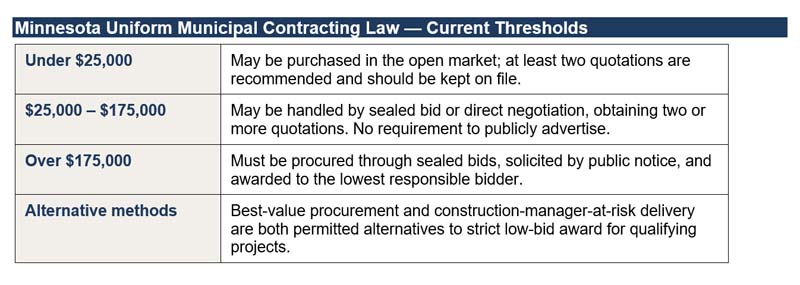
Public construction contracting is governed by state statute, and the rules are less flexible than a private negotiation. In Minnesota, most cities, counties and other local governments follow the Uniform Municipal Contracting Law (Minnesota Statutes Section 471.345), which sets dollar thresholds for how a contract must be procured. The specific numbers vary by state, but the structure below is a useful model for how these laws typically work.
A few terms worth knowing before you bid your first public job:
Lowest responsible bidder: On a traditional sealed-bid project, the contract must go to the lowest bidder who is also deemed “responsible” — meaning qualified, financially sound and capable of performing the work. Being cheap isn’t enough if you can’t demonstrate capacity.
Best value procurement: An alternative to strict low-bid award that lets the owner weigh price alongside qualifications, approach and, in some cases, an interview — useful for design-build or more complex projects.
Construction manager at risk (CMAR): A delivery method where a construction manager is brought on during design to provide cost input, then holds the trade contracts and a guaranteed maximum price during construction — common on larger civic buildings like performing arts centers.
Performance and payment bonds: Public owners typically require both, guaranteeing the project will be completed and that subcontractors and suppliers will be paid. Bonding capacity is often the real limiting factor for a smaller company sizing up its first public job, not the estimate itself.
Prevailing wage: Under Minnesota Statutes Sections 177.41–177.44, most state-funded construction and public works projects over a modest dollar threshold require contractors to pay a certified prevailing wage rate by trade and county, with certified payroll reporting throughout construction. City-funded projects may carry the same requirement under local ordinance even without state dollars involved, so check the bid documents rather than assuming.
Always read the actual bid documents and consult your state’s version of these laws — thresholds and rules change by legislative session, and dollar figures cited here reflect the framework in place for Minnesota in 2026. The League of Minnesota Cities and the Office of the State Auditor both publish plain-language guides to the bidding law that are worth bookmarking if you plan to bid public work regularly in this state.
Where to Look: Public Sources Every Municipal Bidder Should Bookmark
One of the quiet advantages of public work is that so much of the homework is free. Nearly everything in this article — the bidding thresholds, the prevailing wage rules, the funding stories behind both case studies — came from public documents anyone can pull up. The Sources section at the end of this article is organized the way a contractor might actually research a target market, and it’s worth treating as a working reading list rather than a bibliography.
Start with the rulebook. The Minnesota Statutes (Section 471.345 for municipal contracting, Sections 177.41–177.44 for prevailing wage) are the final word, and the Office of the State Auditor and League of Minnesota Cities publish plain-language guides that explain them. Both are free, and both are written for city staff, which means they tell you what the person on the other side of your bid is reading.
Read the owner’s own project page. Cities that build public facilities often post updates, schedules and background on a dedicated page. The City of Otsego’s fire station and construction progress pages are good examples of what a bidder can learn about an owner’s priorities without making a single phone call.
Follow the general contractor’s news. Construction managers and general contractors routinely publish project announcements and spotlights. Kraus-Anderson’s coverage of the Otsego station is a useful look at how a regional builder describes its own scope, and it’s a quick way to learn which firms are winning public work in your area.
Use trade and local press to fill in the money story. Engineering News-Record and REBusinessOnline cover project delivery and contractor awards, while MPR News and community papers like the Elk River Star News cover the votes, levy decisions and public debate that decide whether a project moves forward.
Cross-check before you cite. Figures and timelines can differ slightly between an owner’s page, a contractor’s release and a news report, and thresholds in the statute change from session to session. Treat any single source as a starting point and confirm dollar amounts and dates against the primary document before they go into a bid or a proposal.
Case Study 1: City of Otsego Fire Station
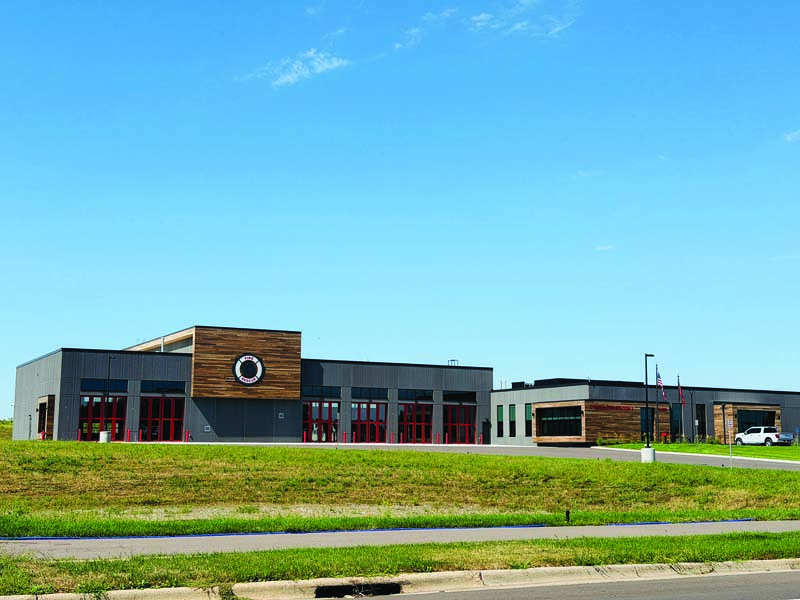
Otsego, a fast-growing city in the northwest Twin Cities metro, broke ground in 2025 on its first-ever, city-operated fire station — a milestone more than two years in the making after the city council voted in 2022 to establish its own fire department rather than continue contracting for coverage. Kraus-Anderson completed the 35,000-square-foot facility in May 2026, on a site at the southwest corner of Odean Avenue and 75th Street Northeast.
The building was designed by Wold Architects and Engineers around the core functions any fire station needs: large apparatus bays and gear storage sized for quick mobilization, 24-hour living quarters for career and part-time staff working a combination staffing model, and dedicated training areas and classrooms that double as space for community programs such as CPR training and public safety workshops. The project also incorporated energy-efficient lighting and water-saving fixtures, reflecting a now-common expectation on public buildings that they perform efficiently over their full service life, not just on move-in day.
The financing tells its own story about municipal construction. City officials approved an 18% property tax levy increase for 2026 to help cover the cost of the department and station, and the project drew a packed crowd to a December 2025 council meeting before construction wrapped the following spring.
A single-owner, single-purpose building like this fire station is often the most realistic entry point for a small or mid-size contractor. The scope is well defined, the owner is a single city rather than a multi-agency partnership, and the specialty trades involved — metal building envelope, doors and hardware sized for apparatus bays, insulated systems — line up closely with skills already common in post-frame and metal-building work. If you’re new to public bidding, a facility like this, or a public works garage or storage building of similar scale, is a better first target than a large cultural venue with a multi-firm design and construction team.
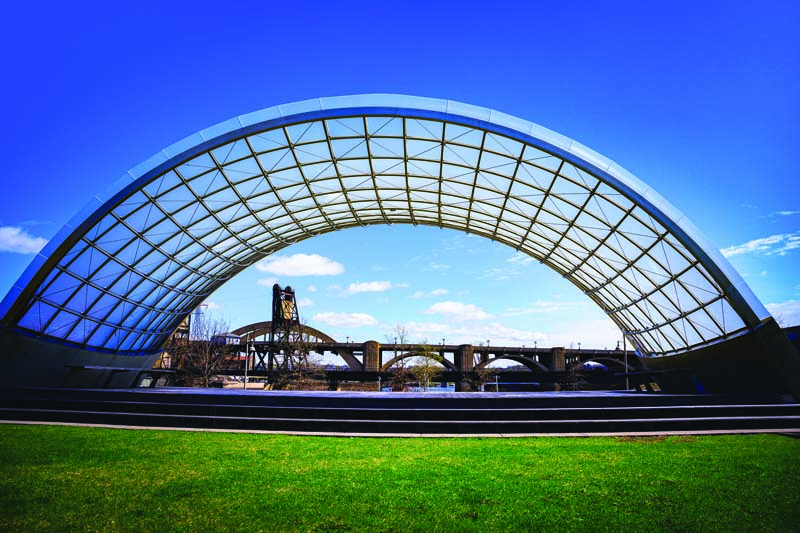
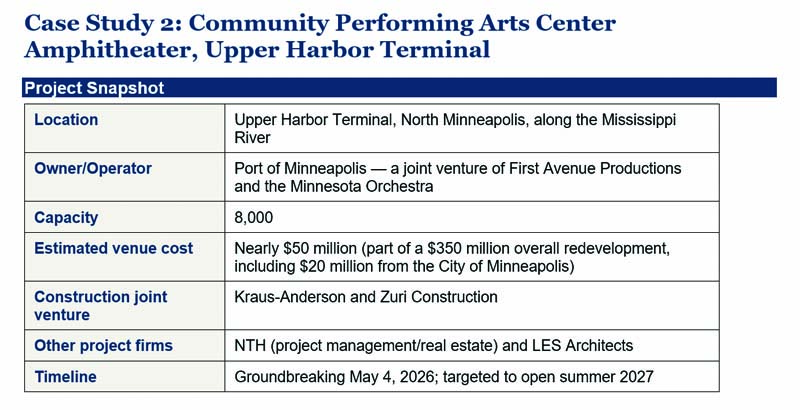
At the other end of the municipal building spectrum sits the Community Performing Arts Center, an 8,000-capacity outdoor amphitheater rising on Minneapolis’s Upper Harbor Terminal, a formerly industrial, 48-acre site that stretches roughly a mile along the Mississippi River. City, county and state officials joined community leaders in May 2026 to break ground on the venue, one of the first vertical structures to come out of a $350 million, multi-phase redevelopment that has been in planning since a 2021 coordinated development plan.
A Kraus-Anderson and Zuri Construction joint venture is building the amphitheater, with NTH providing project and real estate management and LES Architects, both Minneapolis firms, handling design. Once complete, the venue will be operated under a partnership between First Avenue Productions and the Minnesota Orchestra, hosting roughly 50 ticketed shows a year plus community programming, with $3 from every ticket reinvested locally through the African American Community Development Corporation under a city-approved Community Benefits Agreement.
The amphitheater is only one piece of the broader Upper Harbor Terminal plan, which also includes a Minneapolis Park and Recreation Board riverfront park opening in 2026, affordable housing, a health and wellness hub, commercial space and new streets and utilities already built by the city. Financing came together in stages — including a $12.5 million state bond-funded grant accepted by the Minneapolis City Council and private fundraising led by the Minnesota Orchestra — a reminder that large public-private cultural projects can take years to fully fund even after design work is underway.
A project this size isn’t a realistic general-contractor target for most Rural Builder readers, and that’s fine — the opportunity here is downstream. Large joint ventures on projects like this routinely need specialty subcontractors and material suppliers: structural steel erection, metal roofing and wall panel systems, doors and hardware, site utilities and concrete work. The path in is rarely a direct bid to the owner; it’s getting known to the general contractor or construction manager — in this case a Kraus-Anderson/Zuri joint venture — early enough to be invited to bid the trade packages once they’re released.
Choosing Your Envelope and Door Partners
Whether you’re bidding as a general contractor on a small public building or pricing a trade package under a larger firm, the products you specify and the manufacturers behind them are part of your bid. Municipal owners and their architects tend to ask harder questions about ratings, warranties and long-term maintenance than a typical ag customer does, and a manufacturer that can answer them quickly makes your proposal stronger. The Resources section at the end of this article lists companies in four product categories that matter on nearly every public building. A few thoughts on how to use it:
Siding and Roofing
Metal panels are the common language between agricultural, commercial and municipal construction. Central States Manufacturing and Klauer Manufacturing each publish extensive profile, finish and trim information, and Central States offer both exposed-fastener and concealed-fastener options. For a first public project, the practical question is rarely whether a panel can do the job; it’s whether the manufacturer can document the performance the architect’s specification calls for. Ask early for finish warranties, wind-uplift test data and color availability, and confirm lead times before they become a schedule problem.
Doors
Doors are where a fire station or public works garage differs most from a farm shop. Apparatus bays and equipment garages need wide openings that operate reliably and often, in all weather. The manufacturers listed in the Resources section represent two different approaches. Schweiss Doors and PowerLift Hydraulic Doors build hydraulic doors in custom sizes, and the one-piece hydraulic design is described by Schweiss, and by a PowerLift dealer, as swinging outward to act as a canopy when open. TracRite Doors and DBCI build steel roll-up doors that coil above the opening, an option the manufacturers position for storage, industrial and light-commercial openings. For smaller garage-style openings, such as an administrative wing, a community building or a park shelter, Kevmar offers carriage house and custom garage doors in glass, steel and molded fiberglass. Which approach fits depends on the building’s clearances, wind and code requirements, and the owner’s maintenance preferences, so ask each manufacturer for sizing limits, ratings and installation support before you price an opening.
Skylighting
Natural light is a recurring request on public buildings, from training rooms to vehicle bays to open-air shelters. Palram’s Suntuf and SunSky corrugated polycarbonate panels are offered in profiles designed to match common metal roofing and siding, which makes them a straightforward way to add daylight to a metal-clad building, and Palram states that daylighting can reduce lighting and energy costs. As with any manufacturer claim, ask for the test data and installation details behind it, and confirm that the panel profile matches the roof and wall panel actually specified.
Treat your suppliers as part of your qualifications package. When you bid your first public job, a one-page summary of the manufacturers you plan to use, with links to their published specifications and warranties, shows the owner and architect that you’ve done the homework. Call the manufacturer’s technical support line before bid day, not after you win, and ask which of their products have been used on public buildings. Many manufacturers will gladly point you to a regional representative or an architect-facing specification contact.
A Six-Step Roadmap to Your First Municipal Contract
If you’re a builder or supplier who has never pursued public work, here’s a practical sequence for getting from “interested” to “bidding.”
Get registered — Register with your state’s contractor registration or licensing board, and get your company listed as a vendor with the cities, counties and school districts in your service area. Many public owners maintain a vendor or plan-holder list used to notify prequalified companies of upcoming bids.
Build your bonding capacity — Talk to a surety bond agent before you need one. Your bonding capacity — not your estimating skill — is usually what caps the size of public project you can realistically pursue. Establishing a relationship and a track record with a surety early makes it much easier to bond a larger job later.
Start small and local — Bid smaller quotation-range projects (in Minnesota, the $25,000–$175,000 direct-negotiation tier) with a city or county you’d like to build a relationship with. A well-executed small project is the best reference you can have for a larger sealed-bid job down the road.
Watch the pipeline, not just the bid board — Follow capital improvement plans, council and county board agendas, and state bonding announcements. By the time a project hits the plan room, the program and budget are already locked — the real positioning window is a year or more earlier.
Attend pre-bid meetings — Pre-bid or pre-proposal meetings are where you learn the unwritten priorities of a project, meet the architect and construction manager face to face, and signal to the owner that you’re a serious, prepared bidder.
Deliver, document, and ask for the next one — A public owner’s institutional memory is long. Finishing on time, on budget, and with clean documentation is what turns a first small contract into an invitation to bid the next, bigger one.
Positioning Your Company Before the Bid Goes Out
Winning municipal work is as much about relationship-building as it is about estimating. A few specific tactics worth building into your business development routine:
Get on general contractors’ subcontractor lists. Firms like Kraus-Anderson that regularly win public work maintain qualified-subcontractor databases; being in that database is often how a smaller specialty contractor gets invited to bid a trade package on a large civic project.
Attend industry and municipal association events. State municipal leagues, county engineer associations and regional economic development groups hold conferences where public project pipelines are discussed well before formal bid advertisements.
Build a public-project portfolio, even a small one. A single completed public works building or fire station renovation, documented with photos and a reference contact, does more to win your next public bid than a much larger private job.
Understand joint ventures and teaming. On larger projects, a joint venture between a large regional firm and a specialty or minority- or women-owned business is common and sometimes required by the owner’s community benefits policy. If you fit that profile, make sure larger contractors bidding regional work know you exist.
Track prevailing wage and certified payroll requirements before you bid, not after. Underestimating labor cost because a bid didn’t flag prevailing wage applicability is one of the more common — and most expensive — mistakes a first-time public bidder makes.
Common Pitfalls to Avoid
Underestimating bonding requirements. Confirm the required performance and payment bond amounts early; a great price is worthless if you can’t get bonded for it.
Missing the prequalification step. Some owners require prequalification of bidders before a project is even advertised — miss that window and you can’t bid at all, regardless of price.
Treating public bid documents like a private contract. Public bids are strictly governed by statute; late submissions, missing bonds, or non-conforming bid forms are typically disqualifying with no room for negotiation.
Ignoring prevailing wage on city-funded (not just state-funded) work. Some cities apply prevailing wage requirements by local ordinance even when no state dollars are involved — always check the specific bid documents.
Specifying a product you can’t document. A panel, door or skylight that works in the field but lacks the test data, ratings or warranty paperwork the specification calls for can sink a submittal. Gather manufacturer documentation before you price the job.
Waiting for the bid advertisement to start positioning. By the time a project is formally advertised, the architect, construction manager and often the general contractor relationships are already established. Early engagement matters more in public work than in private work.
What This Means for Builders and Suppliers Going Forward
Neither of the two projects featured here is a post-frame building in the traditional sense, and that’s the point of this issue’s project focus: municipal construction spans a wide range of structural approaches, and the fire station, community center or park building going up in the next county over may be exactly the kind of work a metal-building contractor is equipped to bid — or supply components for — even if it isn’t built exactly like the projects that have historically filled these pages.
Rural Builder will continue tracking municipal and public-sector construction alongside the agricultural and light-commercial projects that remain part of this magazine’s coverage. If your company is working on a fire station, public works facility, community building or other municipal project, send your project photos and details to the editorial team for possible coverage in a future issue.
Sources & Resources
Codes, Standards & Industry Associations
- Kraus-Anderson krausanderson.com• Fire Station — City of Otsego, MN — https://www.otsegomn.gov/462/Fire-Station
- City of Otsego, MN — otsegomn.gov
- MPR News — mprnews.org/story/2026/05/04/officials-break-ground-for-new-amphitheater-in-north-minneapolis
- Engineering News-Record — enr.com/articles/62327-joint-venture-to-build-upper-harbor-amphitheater-in-north-minneapolis
- City of Minneapolis — minneapolismn.gov
- Home — Upper Harbor Amphitheater — minneapolisamphitheater.com/
- Office of the Minnesota State Auditor — auditor.state.mn.us/media/jgpleuza/city-bidding-and-contract-requirements.pdf
- League of Minnesota Cities — lmc.org/resources/competitive-bidding-requirements-in-cities/
- Minn. Stat. § 471.345 — Uniform Municipal Contracting Law — revisor.mn.gov/statutes/cite/471.345
- Prevailing Wage — Minnesota Department of Labor and Industry — https://secure.doli.state.mn.us/prevwage/
- Minnesota’s 2026 Prevailing Wage Rates: What Contractors Need to Know Before Bidding on Public Projects —https://northstarlaw.com/minnesotas-2026-prevailing-wage-rates-what-contractors-need-to-know-before-bidding-on-public-projects/
- Central States Manufacturing centralstatesco.com
- Klauer Manufacturing Company klauer.com
- Schweiss Doors schweissdoors.com
- PowerLift Hydraulic Doors powerliftdoors.com
- TracRite Doors tracrite.com
- DBCI dbci.com
- Kevmar kevmarmfg.com
- Palram Americas palram.com/us