Without a solid foundation, even the best building will have structural issues. Because of the importance of foundations, it’s good for builders to understand a bit of what engineers may pass along in a design and why it matters. It’s especially important when the buildings get bigger or closer together. Even when specific engineering isn’t required, understanding this information will benefit all your buildings.
Soil Testing for a Foundation
As a soil scientist, I’ve dug a lot of holes for soil testing, with most about six feet deep, as that’s the depth that we describe soils for mapping purposes. Even at this depth, which can be shallower than many foundations, quite a bit can change about the soil from the surface on down. It’s not uncommon to encounter several different materials or layers when digging, and these materials will all act differently under load and with the addition or subtraction of moisture. The density, texture, minerals, and presence of aggregate can all affect how soil will act under load.
Typically, the greater the dry density of the soil, the more compact and stronger that soil will be. This means it can carry a greater load per unit area or pressure (pounds per square foot). If the soil can handle greater pressure, then it will likely be a better foundation. If the soil can’t handle greater pressure, then the site will require a larger area of foundation footings to support the load (or more piers of the same size).

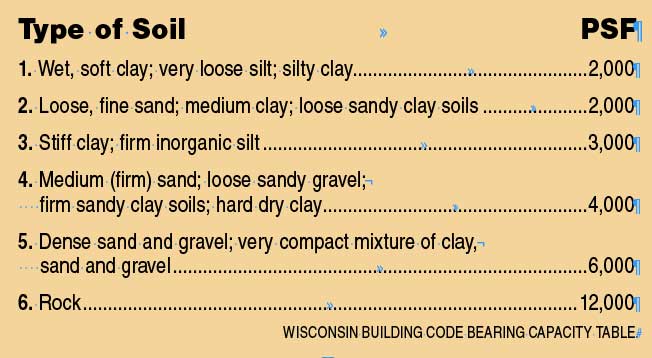
Local building codes usually include criteria for the size of foundations of various types, and likely have a minimum requirement for bearing capacity, which is the pressure the soil can handle without deforming. For instance, in Wisconsin, the soil must have a bearing capacity of 2,000 pounds per square foot, unless the foundation has been designed through structural analysis (engineering).
A simple identification of the soil’s texture (sand, silt, and clay percentages) and presence or absence of organic matter will usually be adequate, as most nonorganic soils will achieve the 2,000 pounds per square foot mark. From this point, once the building dead load with added live load —and any other applicable load, such as snow load — are combined, the total load is divided by the soil bearing capacity to determine the footing area (square feet) required. This required footing area can be divided among piers for post-frame construction or may include trench footings or continuous footings depending on the type of construction.
sherez-stock.Adobe.com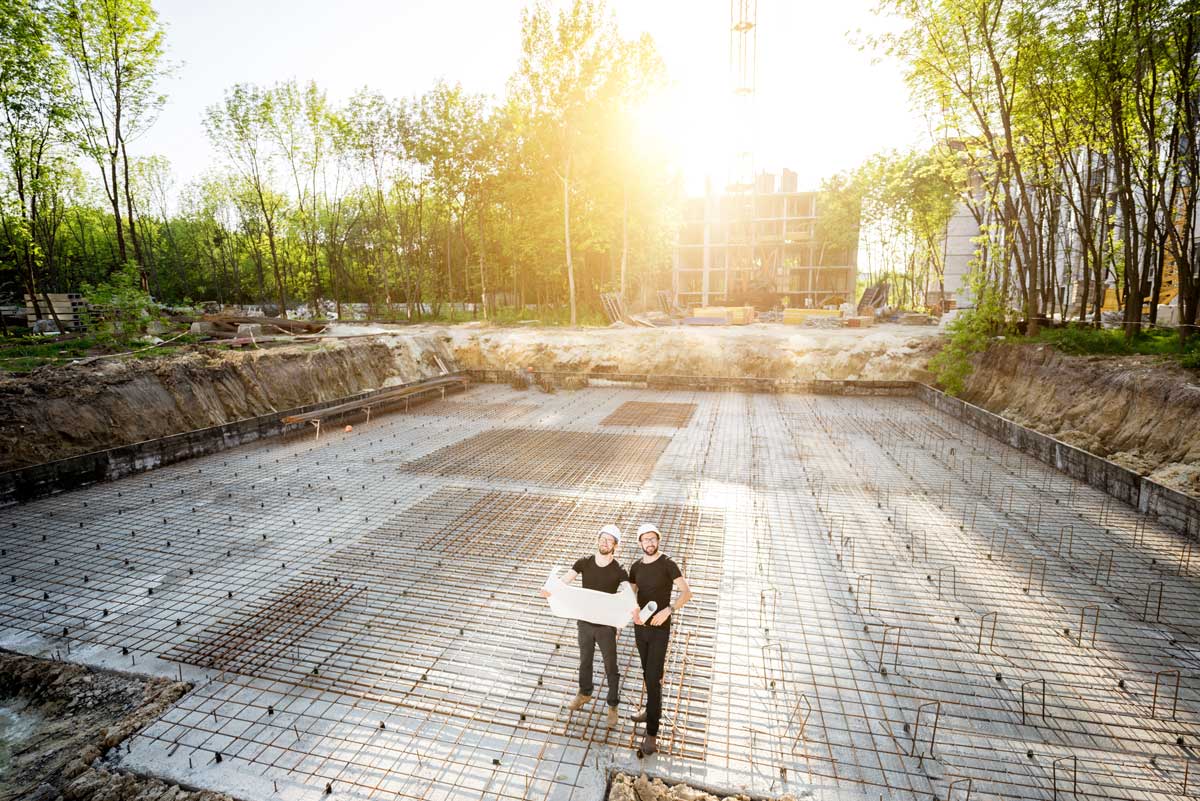
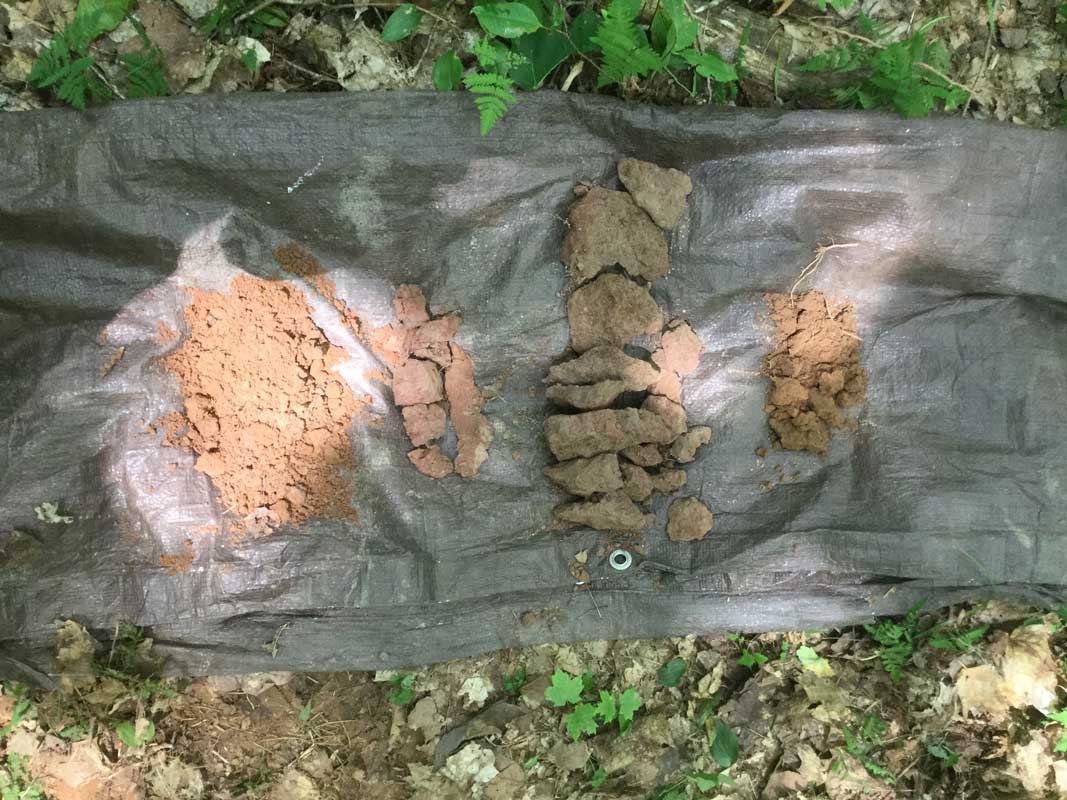
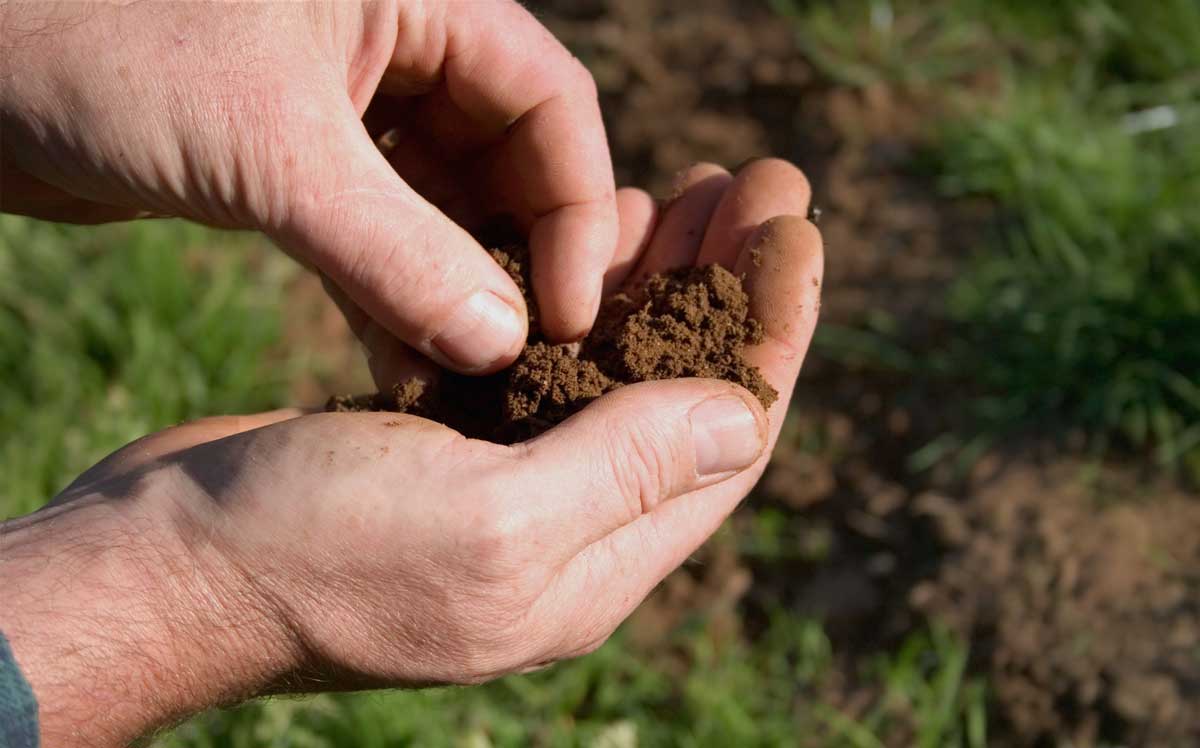
The soil layers from a single soil analysis hole has been separated into four distinct types.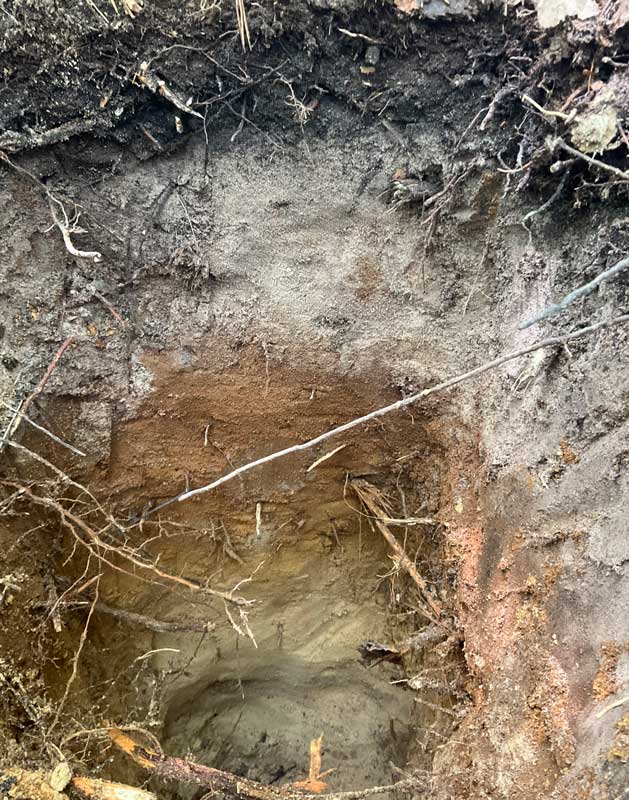
A typical soil analysis hole is about six feet deep. That’s the depth that soil maps extend, which is deeper than some foundations. It’s not uncommon to encounter several layers of different materials when digging, and these materials will all act differently under load and with the addition or subtraction of moisture.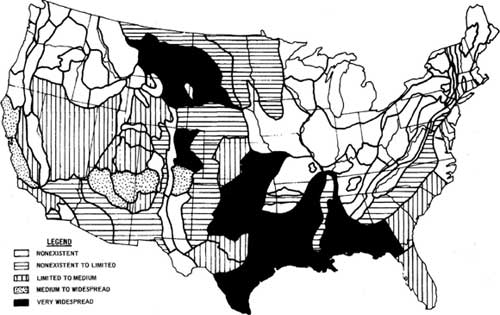
Figure 7-18. Estimated location of swelling soils (from Witezak, 1972). The DOT has charts and graphs to help narrow down soil types. Search online for “Geotechnical Aspects of Pavements Reference Manual.” This diagram is still used today but is from 1972.
This less precise type of evaluation of soil bearing capacity is sufficient in many cases, but for high-value situations or heavy buildings, it may be necessary to take measurements using a plate load test. For this test, a steel plate is loaded until the soil begins to deform or compress. Usually, multiple successive loads are tested, each for a set time, and compression is measured with precision gauges. The test allows for a highly accurate measurement of the soil’s bearing capacity and, in cases where the soil-bearing capacity is high, a more efficient sizing of footings. In those situations, the footings can be smaller when the bearing capacity is higher for the same total building load. A geotechnical engineer conducts the plate load test, and an engineer uses the resulting information to design the foundation.
Soil testing involves more than just measuring bearing capacity. Some soil minerals shrink and swell while others do not. I have a 1,600 square foot basement with one continuous slab with no cracks. My contractor father-in-law marveled at this and thought the concrete guys did an amazing job. He’s right that they did, but maybe more importantly for this residential slab miracle is that the house was cut into sandy compacted glacial till with few if any expanding clays. This sandy compacted glacial till means that the material is dense. (Who knows how thick the ice was atop it several millennia ago.)
Because it’s glacial till, it contains some stones and a bit of every size soil particle from sand to clay but containing more of the sand size with just enough clay to hold everything together. This makes for a very dense material with a consistent bearing capacity throughout. That soil material, along with an excellent slab pour, created a large slab with no cracks.
Soil information can be found at the USDA’s Web Soil Survey (websoilsurvey.nrcs.usda.gov/app). The site makes it easy to search by geographic location.
Engineering a Foundation
The coefficient of linear extensibility (COLE) is how much the soil can expand. There are a few different formulas for this. Soil scientists use (Lengthmoist-Lengthdry)/Lengthdry. If there is no expansion, the answer is 0, with anything greater than 0 being the percentage (as a decimal) that the soil may expand upon wetting. If the soil materials are significantly expansive, then this has to be dealt with in how a foundation is constructed and how the building’s floor and basement might be tied together or left floating. It’s often recommended to dig deeper to put a foundation on non-expansive material if possible.
My nephew, now studying for his structural engineering exam in Kansas, likes to tie foundations to slabs, as this reduces cracking in the slabs and unevenness in floors and doorways, but he notes that expansive soils require different treatment. In some cases, this could mean slabs poured in sections with expansion joints and footings that aren’t linked together. Not linking slabs to foundations allows that a foundation that may be in non-expansive material (and won’t move) can support a building with a slab that’s allowed a little room to move if the slab is atop material that might expand. Alternatives include bringing in of fill to compact on site. I remember seeing sectioned slabs with expansion joints where my sister once lived in Colorado in her basement. Most of the Midwest (except Kansas, parts of Missouri, and Minnesota) doesn’t have to deal with expanding soils.
Other Considerations
Other considerations include consistency of materials across all footings, consistent depths of footings (within reason), and sometimes lateral loads. In speaking with my nephew, the budding structural engineer, he emphasized that the larger or heavier the project, the more important it is to have consistent materials (though they strive to always have uniformity to avoid differential settling) that the footings are in/on. He suggested that everything should be either on rock or soils, and the same soils (or rock), for all footings to avoid differential settling. And generally, while deeper foundations can handle a higher pressure, they aren’t always necessary, as long as everything is below frostline and can handle the load.
He did suggest that uniform depth of footings was ideal but that some slope to a foundation can be accommodated to keep deeper footings in the same material or to accommodate a changing grade and still keep everything below the frostline. Other tests done on soils could include borings with cutting logs to determine the depths and thickness of soil features and friction factor measurements, but these are only likely to be necessary for very large-scale construction or where large buildings are in close proximity.
Conclusion
An understanding of the basics of soil testing and engineering for a building’s foundation can be very helpful to builders and contractors. The information can provide valuable insight, improve communication among stakeholders, help reduce potential construction mistakes and delays, and lead to the best results and satisfied clients.
Jacob Prater is a soil scientist and associate professor in Wisconsin. His passion is natural resource management along with the wise and effective use of those resources to improve human life. RB