Originally Published as: Moving Air, Maximizing Performance: Fan Setups and Applications for Agricultural and Rural Buildings
Whether you’re managing a livestock barn, a grain storage facility, a shop, or a multi-use agricultural complex, proper fan selection and placement can mean the difference between a healthy, productive environment and costly losses from heat stress, moisture damage, or poor air quality.
Today’s agricultural fan market offers a wide range of options, from basic box fans to sophisticated variable-speed systems integrated with environmental controls. Understanding which setup is right for your application — and how to install it for maximum effectiveness — is the foundation of any successful rural building ventilation strategy.

Understanding the Basics: Types of Agricultural Fans
Not all fans are created equal, and matching the right fan type to the right application is the first step toward a successful ventilation plan. The most common fan types used in rural and agricultural settings fall into several broad categories.
Axial (Propeller) Fans
Axial fans are the workhorses of agricultural ventilation. They move large volumes of air at relatively low static pressure, making them ideal for open structures like poultry houses, hog confinements, dairy barns, and equipment sheds. These fans are typically mounted in sidewalls or endwalls and are used in both exhaust and circulation configurations. Their simple design makes them easy to maintain, and their efficiency at high airflow rates makes them cost-effective for continuous-duty applications.
Centrifugal (Squirrel Cage) Fans
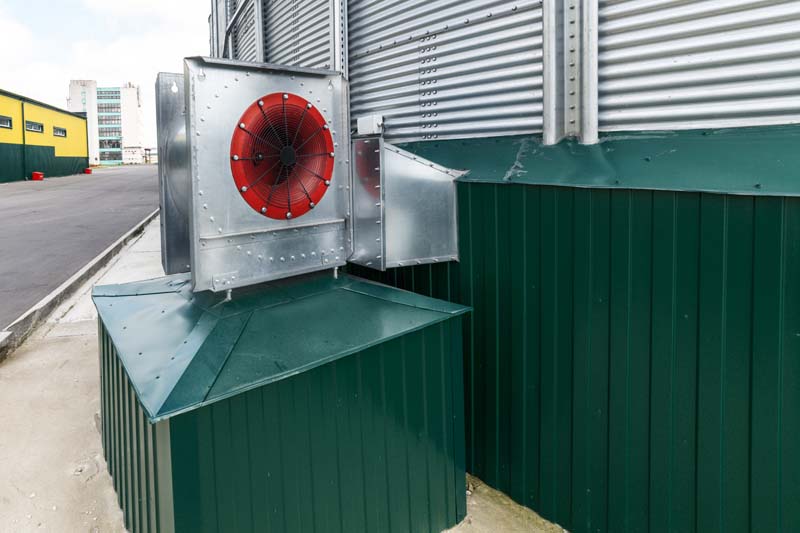
When ductwork is involved, centrifugal fans are the preferred choice. These fans generate higher static pressure, allowing them to push or pull air through longer duct runs, filters, or heat exchangers without significant performance loss. They are commonly found in grain bin aeration systems, ventilated storage rooms, and mechanical ventilation setups where air needs to travel through conditioned or filtered pathways before reaching the target space.
High-Volume, Low-Speed (HVLS) Fans
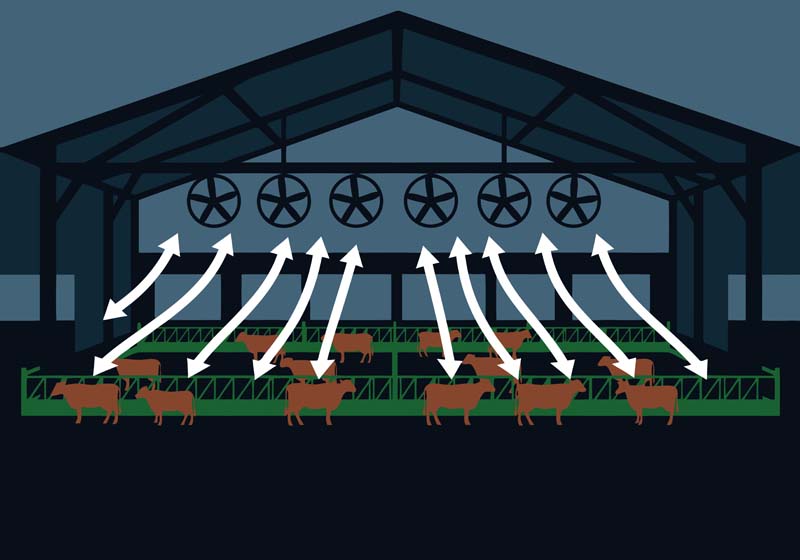
HVLS fans have become increasingly popular in large open buildings such as free-stall dairy barns, horse arenas, and workshop spaces. These large-diameter ceiling fans — typically ranging from 8 to 24 feet across — rotate slowly but move enormous volumes of air across a wide area with minimal energy consumption. A single HVLS fan can often replace a half dozen or more smaller high-speed fans, reducing both energy costs and maintenance demands. Their gentle, even airflow is particularly valued in dairy operations, where consistent air movement reduces heat stress without creating drafts that can chill calves or wet animals.
Circulation and Destratification Fans
In heated buildings like workshops, processing facilities, or indoor riding arenas, thermal stratification — where warm air pools near the ceiling while the floor level remains cold — is a common and costly problem. Destratification fans, typically smaller high-speed units mounted at ceiling height, break up these temperature layers and redistribute warm air downward. This can significantly reduce heating costs while improving comfort and working conditions throughout the building.
Ventilation Strategies: Natural vs. Mechanical
Before selecting fans, builders and operators must understand the two fundamental ventilation philosophies — and how they can work together.
Natural ventilation relies on wind and thermal buoyancy (the tendency of warm, moist air to rise) to move air through a building. Ridge vents, open sidewalls, curtain sidewalls, and strategic building orientation all play roles in maximizing natural airflow. This approach is low-cost and energy-free, but it’s also dependent on weather conditions and can be unreliable during hot, calm summer days — precisely when ventilation is most critical.
Mechanical ventilation uses fans to create controlled, predictable airflow regardless of outdoor conditions. It can be designed as a positive-pressure system (fans push fresh air in), a negative-pressure system (exhaust fans pull stale air out, creating a vacuum that draws fresh air through inlets), or a neutral system that balances both. Negative-pressure tunnel ventilation has become the industry standard in poultry and swine production, where precise control over air speed and direction is essential for animal performance.
Many modern rural buildings use a combination of both approaches — curtain sidewalls or ridge vents for mild-weather natural ventilation, supplemented by mechanical systems that kick in during extreme heat or cold. Automated environmental controls can monitor temperature, humidity, and CO2 levels and adjust fan speeds accordingly, creating a dynamic system that optimizes both animal welfare and energy efficiency.
Application-Specific Fan Setups
Poultry Houses
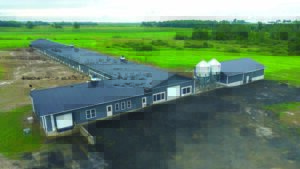
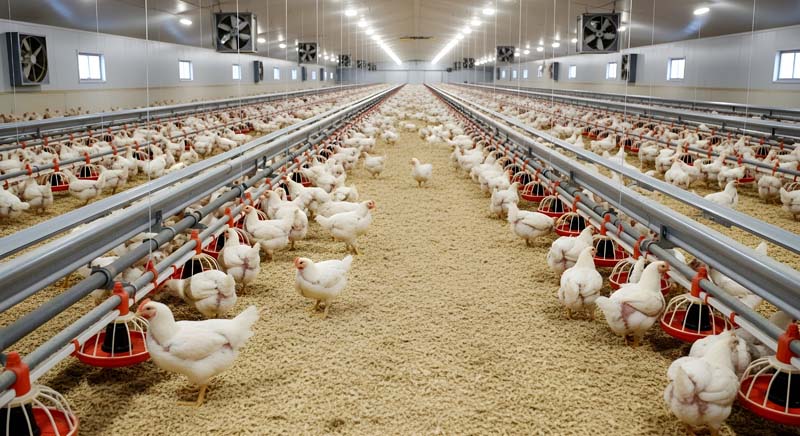
Tunnel ventilation is the gold standard in modern broiler and layer operations. Exhaust fans — often large 48” or 52” diameter units — are mounted in one endwall, while screened inlets at the opposite end allow fresh air to enter. This creates a strong, directional airflow the length of the building, generating a wind-chill effect that keeps birds comfortable even in peak summer conditions. Staging fans in multiple banks, controlled by thermostats or environmental computers, allows operators to ramp airflow up or down based on real-time temperature readings.
Dairy and Beef Cattle Facilities
Heat stress in dairy cattle is a well-documented production killer, suppressing milk output and reproduction rates even at moderate temperatures. HVLS fans positioned over the feed lane, resting area, and holding pen are now considered essential equipment in competitive dairy operations. Supplementing HVLS fans with sprinkler or soaker systems — which wet the cows before the fans evaporate that moisture — delivers aggressive cooling with remarkable efficiency. For beef feedlots and calf housing, combinations of wall-mounted axial fans and natural ridge ventilation are commonly used to balance airflow and moisture control.
Swine Confinements
Ventilation in swine facilities must manage not only temperature but also ammonia, hydrogen sulfide, and other gases produced by manure. A tiered ventilation system using variable-speed fans of multiple sizes is standard practice: small fans run continuously at minimum ventilation rates during cold weather to maintain air quality; larger fans stage on as temperatures rise and heat and gas loads increase. Careful attention to inlet design ensures that incoming cold air mixes with room air before reaching pig level, preventing chilling in young or finishing animals.
Grain Storage and Aeration Bins
Aeration is the primary tool for maintaining grain quality in storage. Centrifugal aeration fans force ambient air up through the grain mass, equalizing temperature and moisture throughout the bin and preventing the hot spots and moisture migration that lead to spoilage. Fan sizing for grain bins is typically calculated by the CFM-per-bushel standard — most agronomists recommend between 0.1 and 0.2 CFM per bushel for basic temperature management, while faster drying systems may target 1.0 CFM per bushel or higher. Automated aeration controllers use outdoor temperature and humidity sensors to run fans only when conditions are favorable, maximizing efficiency.
Machine Shops and Multi-Use Buildings
Farm shops, equipment storage buildings, and multi-purpose rural structures benefit greatly from both exhaust ventilation and circulation fans. Roof-mounted power ventilators can quickly purge heat that builds up under metal roofs during summer. Destratification fans improve heating efficiency in winter. Where welding, spraying, or other fume-producing work takes place, localized exhaust fans or dedicated ventilation hoods may be required to meet safety standards and protect worker health.
Key Considerations for Fan Selection and placement
When specifying or installing fans for any rural application, these core principles apply:
Size for the worst case. Fan systems should be engineered to handle peak summer conditions, not average conditions. An undersized system that fails during a heat event can cost far more in animal losses or product damage than the savings realized by cutting corners upfront.
Match CFM to the space. Calculate the total cubic footage of the space and determine the number of air changes per hour required for your application. Livestock buildings typically target anywhere from 30 to over 100 air changes per hour at peak ventilation, while storage facilities may need far fewer.
Prioritize energy efficiency. Look for fans with high CFM-per-watt ratings and consider variable-speed drives that allow fans to run at reduced speeds during mild conditions. The energy savings over a fan’s lifetime can far exceed its initial cost premium.
Plan for maintenance access. Fans in agricultural environments face dust, moisture, and corrosive gases that accelerate wear. Specify fans with corrosion-resistant housings and blades, and design installations that allow for regular belt inspection, lubrication, and cleaning without requiring scaffolding or specialized equipment.
Protect against back-draft. Shutter dampers that close when fans are off prevent cold outside air from infiltrating the building in winter and reduce heat gain in summer. Always specify fans with quality dampers, and inspect them regularly to ensure they open and close freely.
The Bottom Line
A well-designed fan system is not an afterthought — it is a core component of a productive, durable rural building. Whether you’re breaking ground on a new hog confinement, retrofitting an aging dairy barn, adding aeration to a grain storage complex, or improving comfort in a farm shop, investing the time and resources to get ventilation right pays dividends every single day the building is in use.
Work with suppliers and engineers who understand agricultural environments, not just residential or commercial HVAC. The demands on a fan running 8,000 hours a year in a dusty, humid poultry house are vastly different from a fan in an office building, and the specifications should reflect that reality.
When air moves right, everything else tends to follow.
Resources
- Purdue University Extension – https://www.extension.purdue.edu/
- University of Minnesota Extension – https://extension.umn.edu/
- University of Illinois BESS Labs – http://bess.illinois.edu/index2.htm
- Penn State Extension – https://extension.psu.edu/
- August McIntosh