Originally Published as: Trends in tunnel ventilation
OCTOBER 2016 FLASHBACK
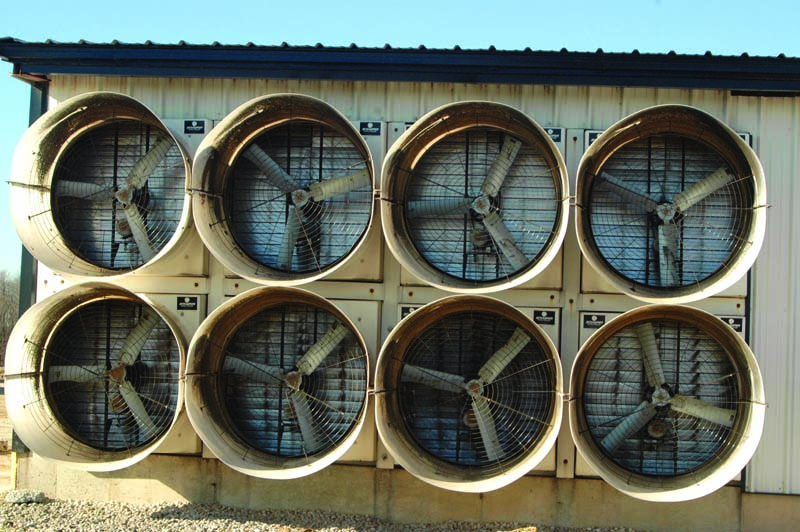
Ten years ago, tunnel ventilation was still winning converts.Coverage described a system built on brute simplicity: negative pressure, a bank of exhaust fans at one end, curtain inlets at the other, and a controller that mostly just turned things on and off. Producers liked it because it worked, and because “it worked” was about as much sophistication as the technology needed to offer.
Now, variable-speed fans modulate airflow instead of cycling on and off. Sensors track humidity, ammonia, and static pressure in real time, feeding controllers that adjust automatically rather than waiting on a producer’s phone alert. Backup power and failure alarms have gone from upgrade to expectation.

The core idea held up. Everything wrapped around it got smarter — proof that good engineering ages well, even when the technology around it doesn’t stand still.
As farm buildings grow in size, and livestock herds grow in numbers, so too are the concerns for proper ventilation.
While natural ventilation is still common—especially in the beef industry—the poultry and swine industries use a lot of tunnel ventilation which uses large fans to generate air movement over the animals. That concept is also showing up in some dairy facilities.
Morgan Hayes, PhD, P.E., University of Kentucky, has worked in several areas of the Midwest and has seen the various trends. She noted: “People are more conscious of heat stress right now and concerned about it. As a result more people have moved from either natural ventilation or traditional sidewall ventilation to tunnel ventilation.
“The poultry industry traditionally uses a lot of tunnel ventilation,” Hayes continued. “The concept with tunnel ventilation is that you pull air in and you move it along the length of the barn with the most air speed that you can gain.”
Fans are located at one end of the barn and the air entry point at the opposite end. Air entry can be either through multiple basic openings or openings designed with evaporative cooling pads. This system is particularly used in the broiler industry and larger fans, in the 48- to 54-inch range, are the most desirable.
For the layer industry, sidewall or cross ventilation is popular. Fans are evenly distributed along the sides of the barn. Air enters through ceiling inlets and is drawn down through the space.
Hayes has seen the swine industry move from more natural ventilation in the Midwest to more mechanical ventilation in the past few years. Some producers are also commonly using 48- and 54-inch fans.
The dairy industry has been taking some steps toward tunnel ventilation systems but the larger dairy barns can require a lot of airflow and the desire for bigger and better fans is an ongoing goal for those facilities. Doug Overhults, PhD, P.E., also with the University of Kentucky, explained: “One of the attractions of the bigger fans is that you have fewer of them to maintain, and for the builder, it’s easier and less costly to put in fewer larger fans than more smaller fans…”
New trends
Tunnel ventilation systems have been around for a long time, but there are some interesting new trends.
Positive pressure ventilation (PPV) “In the swine industry, at least some of the farmers have started using a positive-pressure design for their barns,” said Hayes. “They build barns with filtration systems that push air into the barn rather than pull air out.”
Hayes noted that it requires a fairly large inlet area, “so they build large gables to handle all the filters, or offsets to the side of the barn to allow air into the barns. That’s a really unique and different design. It requires a little different construction because positive pressure means we need to focus on construction methods to keep moisture out of the walls.”
So far, Hayes has only seen the design used for the swine industry. “It’s gained popularity in the Midwest,” she noted. “I think the first barn we saw with this design was about a year-and-a-half ago, but a couple of farmers are using it, or at least testing the waters with their breeding herds, their more valuable animals. For some frame builders, long term, that could be a very interesting topic.”
Direct-drive fans. Another trend that Hayes has seen are direct-drive fans. “Traditionally we’ve had to put a variable speed control before the motor and they’re sort of inefficient when fans go below 100 percent [of operation speed],” she said.
Winter conditions are a case in point when fans are turned down. In those lower ranges, fans become more inefficient.
“And now they’ve come out with a direct-drive motor that’s able to reduce RPM on the fan and maintain or improve the energy efficiency of those fans. It’s an interesting concept for the industry as a whole,” she noted.
The new fans are more expensive, but Hayes believes they could become game changers for winter ventilation systems.
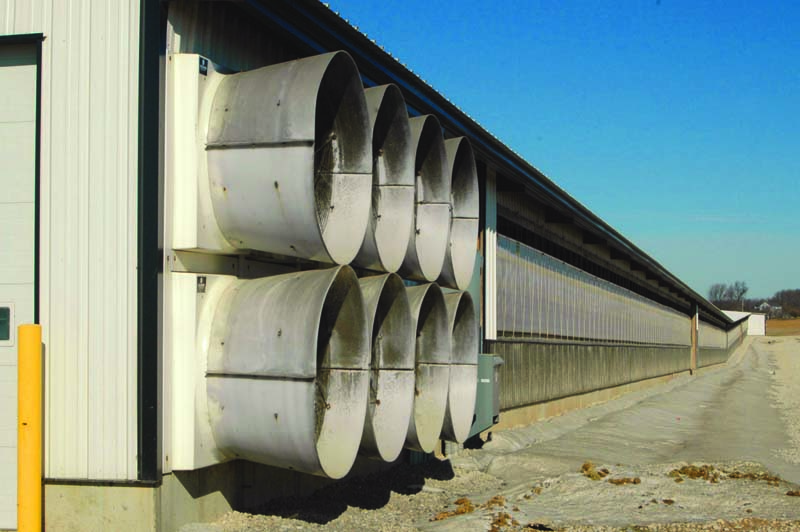
Ventilation basics
The objective of proper ventilation is always the same regardless of the animal, Overhults explained. “The general nature of ventilation is similar in that, in the wintertime, it’s all about removing moisture, ammonia and dust, just keeping the air fresh, supplying oxygen … In cold weather that’s usually a pretty low rate of ventilation,” he said.
“Then you progress to moderate weather when the rate goes up a little and you’re trying to maintain the target temperature in the building. And that target rate would be different for different animals and different growth stages. For poultry, for instance, smaller birds [with the exception of young chicks], you might be looking at temperatures inside that are 75 or 80 degrees; where for pigs you might be looking at 70 degrees or lower. And for dairy cattle the target temperature would be much lower, maybe 55-60 degrees. That makes your ventilation requirements a little different.
“Then you progress into summer, more hot weather conditions. Most all animals needs some cooling of some kind, and you can accomplish some of that just by exchanging the air in the building more rapidly. But air exchange alone usually is not sufficient to get the animals into their desired comfort zone.”
Evaporative cooling pads are a popular cooling system in some parts of the country for tunnel ventilation systems, particularly for poultry and swine. “The effectiveness really depends on what part of country you’re in,” Overhults said. “Where it’s really humid, they don’t work quite as well as they do in dryer climates.”
Evaporative cooling pads are part of the air inlet system located on the end opposite the fans. The incoming air passes through a cellulose pad about 6 inches thick. That pad is wetted and the air evaporates the water as it passes through the pad. The cooling effect can be from 10 to 20 degrees depending on weather conditions.
Problems/Solutions
While most experienced builders make the correct decisions for helping to assure optimum results for tunnel ventilation, there are some common mistakes that are made.
“The most common error is when people are putting in a ventilation system and they don’t have enough openings in the inlet side. You’re looking for fairly large openings for the air to come through, because every time you choke it down, it makes the fan work harder,” Hayes said.
That can happen particularly when a barn is being retrofitted for a larger fan or when a second barn is built using the blueprint of the first. “[The builder] has cut bigger openings for the fans but they haven’t made a bigger opening for the inlet,” Hayes said. “If you are a builder and asked to frame out an additional fan, it would be good to ask if the farmer also wants additional inlet area.”
Another mistake Hayes has seen is fans that aren’t squared into their openings.
“Fans operate best if they go in square into a nice tight opening, properly built for the size of their shroud. So when those aren’t squared or not built right and someone has to jerk them into position and it torques the fan itself, it can change the efficiency on a fan. So make sure those openings are properly sized. It’s like putting in a window: it just doesn’t work well if it’s not a square opening.”
Overhults points to potential electrical problems. “It’s pretty important that they get their electrical system setup so they can operate all these fans. We’ve seen problems with some low voltage at the fans. Some of these barns can get really, really long and the wiring runs are very long. If the wiring is undersized, you can get some excessive voltage drops. I know many builders subcontract someone to do the electrical work, but they need to make sure that the electrician has his ducks in a row, because it does come up as an issue sometimes, and it’s pretty critical and hard to fix.”
Orientation is also important, especially for naturally-ventilated barns. “The best orientation sort of varies with location in different parts of the country. An east-west ridgeline works well in many places but you generally want to limit your exposure to wintertime prevailing winds and maximize your exposure to summertime prevailing winds. Avoiding any nearby airflow obstructions on the site is also important,” Overhults reminded.
Having two barns built too close together can change the wind dynamics. When building a second barn, know what changes may be needed to assure proper ventilation for both barns.
Still other issues arise when a new trend in caring for animals is introduced. An example is compost-bedded pack barns. Overhults has seen these in dairy operations in Kentucky.
A compost-bedded pack barn is an open barn where the cows are housed between milkings. They rest on top of a manure pack that is stirred with a rototiller or shank-type cultivator at least once or twice daily and topped with dry sawdust. “It’s stirred frequently to keep air in it, so it composts,” Overhults said. “It’s relatively dry because the heat generated from the composting action tends to drive off some of the moisture.”
Most compost-bedded pack barns have been built for use with natural ventilation systems and it is important to allow adequate space for the moisture to escape from those barns. Although the composting action tends to drive off some of the moisture, it is critical for the bedded pack not to become too wet Overhults noted. “Having an outlet for moisture in wintertime, a ridge vent, is something we’ve had to talk to people about a lot,” he said. “That’s a pretty important part of the building, to give an air outlet and take advantage of the fact that warm, moist air will rise and needs a place to exit the barn.
Tests reveal efficiency stalls for some 60-inch ag fans Bigger is better only to a point
When it comes to big fans and their benefits for agricultural ventilation, the old logic that bigger is better has hit a snag. Researchers at BESS Lab operated by the University of Illinois at Urbana-Champaign have tested a number of 60-inch fans only to discover that, at a certain point, energy efficiency does not always continue to increase.
Morgan Hayes, Ph.D., P.E., formerly at the University of Illinois, and now at the University of Kentucky as a Livestock Systems Extension Specialist, believes the problem may lie in the dead air space of a fan’s standard design.
“A fan pushes most effectively at the end of the propeller blade,” she explained. “That’s where it can push the most air, on the outside of those blades. The companies that design fans constantly work on the propeller geometries and dimensions to get the most air through a fan. I think with these very large fans the center portion, the sort of dead area of that fan, grows as well and they haven’t successfully been able to move through that dead area to get the efficiency as high as they would like it to be.”
That’s not to say that fan companies won’t find a solution to the problem. They are working on it. But in the meantime, you might want to consider the alternatives.
“The bigger-is-better philosophy is somewhat true, but sometimes you’d be better to have a few more smaller fans depending on the set-up of your barn,” Hayes said.
Bottom line, the 48- and 54-inch size fans, prevalent for tunnel ventilation systems, is still optimum size for efficiency.
“The assumption was always that going from an 18 to a 24 inch, or a 36 to a 48 inch fan, you’re going to move more air and you’re going to do it more efficiently. The trick is, when you get to 60 inches, you can move more air but you can’t do it more efficiently,” Hayes explained.
The industry most affected by the 60-inch fan conundrum is the dairy industry. “The dairy industry has moved the most aggressively to the 60-inch fans, probably because they want air speed with big animals,” Hayes said. “They think: big animals, big fans. The goal is always to move more air through the same size opening by improving that design on the propellers, and to do it with less energy. Energy efficiency has become very important in the last couple years.”
Just remember that, as a general rule, bigger fans are more efficient than their smaller counterparts until you hit that 60-inch mark when efficiency flatlines.
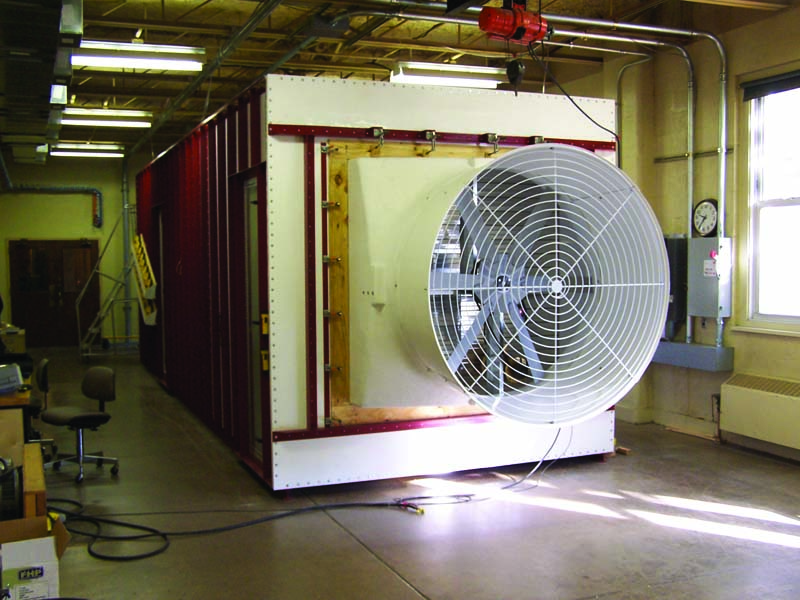
BESS Lab
Not all fans that fit in a given opening perform equally. To determine the most efficient fans available, the BESS Lab is a good place to keep an eye on testing results. The lab was developed in the 1990s in response to the need for testing agricultural fans. Previously, testing was available at a facility that was geared primarily towards commercial and industrial fans. Fan companies that were focused on the ag industry felt a need for a more ag-focused option.
Hayes explained that the lab is “basically a large wind tunnel where we can precisely control air speeds and pressures to determine how well the fan performs. … It’s designed to give you a standardized way to evaluate your fans and to confirm the performance values the company is suggesting a fan can do.”
BESS Lab does not test every fan available, it relies on the fan companies to request their testing services, but because the testing is highly regarded in the field, there are a number of companies that seek the testing to help validate their product claims. Tests conform to official protocol set by the AMCA (Air Movement and Control Association International, Inc.)
Always reference performance data rather than assuming bigger is better. “The data of BESS Labs should give you a best-case scenario of how that fan will perform in the field,” Hayes said, noting that the results should be considered only a guide. “Realistically, your [fan] performance won’t be as good because dust and dirt will build up, but at least it will give you a baseline about how the fans can perform.”
Results are available online. Find them at: http://bess.illinois.edu. Other performance test results can be found there for circulating fans and poultry house light traps.