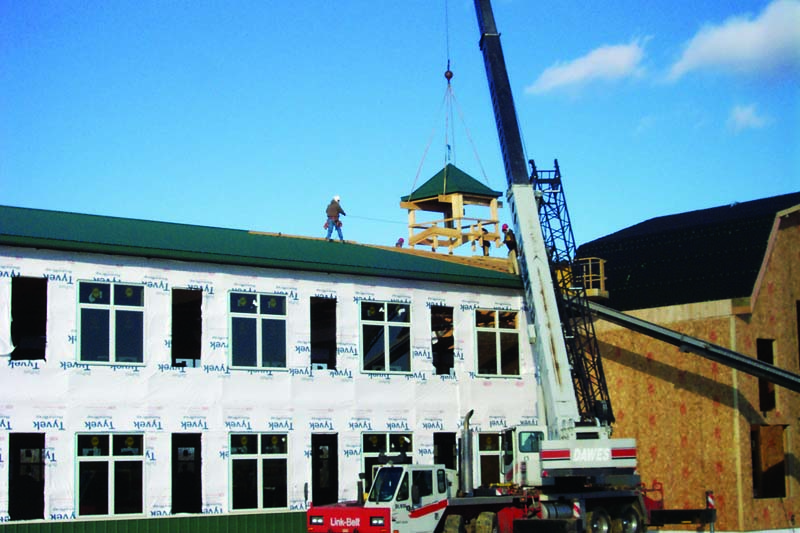
Originally Published as: Sure, it looks like a nice post-frame office structure, but this is Green Building? You’d better believe it.
DECEMBER 2004 FLASHBACK
In 2004, green building was viewed as a costly niche focused mainly on recycled materials and solar panels.
Today, green building is mainstream. Energy efficiency, smart technology, healthier indoor environments, and long-term durability are now standard expectations in many people.
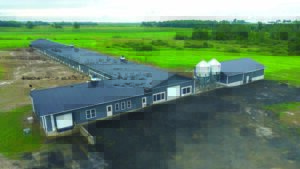
The biggest shift is cultural: builders once had to sell the idea of sustainability. Now many clients ask for it from the start.
Rising energy costs, severe weather, and consumer demand have transformed green building from an environmental statement into a practical business strategy.
The conversation has shifted from “Why build green?” to “Why wouldn’t you?”
Green building. Say it out loud, and any number of images immediately come to mind. Solar panels. Big city architects with trendy glasses. Earthy types who play hacky sack. Funky European designs. Ralph Nader yard signs. Straw bale and newspaper-based building products.
Can you picture it in your head? Good. Now take every preconceived notion you might have had about green building and throw it out the window. It doesn’t have to be that way.
Green building, the current term for building with a focus on environmentally conscious and energy-efficient design, may be stigmatized as a fringe segment of the construction industry, a pursuit for high-minded or tree hugging parties with deep pockets. But that could not be further from the truth — even in rural areas. Green building products and techniques are rapidly gaining popularity with a wide range of builders, subcontractors, designers, and building purchasers, who are proving that buildings do not have to break the bank to respect the environment.
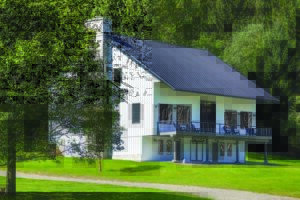
For a perfect example, one needs to look no further than a post-frame building in a town of 800 in the Upper Midwest.
Big Picture
Several years ago, the Organic Valley farming cooperative was looking to build a new headquarters in La Farge, Wis., for its blossoming organization. Organic Valley was growing by more than 30 employees per year, and hoped to provide a facility that was conducive to employee wellness, while also respecting the environment around it.
Organic contacted Morton builder Dan Curran, who had worked with a previous customer researching the Leadership in Energy and Environmental Design program, as well as Energy Star qualified products. “They said they wanted to build as green a project as possible, and they wanted it to be as functional as possible for their people,” Curran says.
The team immediately sought assistance from Wisconsin Focus on Energy, a partnership of organizations that help businesses improve energy efficiency and reduce the need for fossil fuels. WFOE helped put together a two-day, nine-building tour of structures that incorporated various green building techniques.
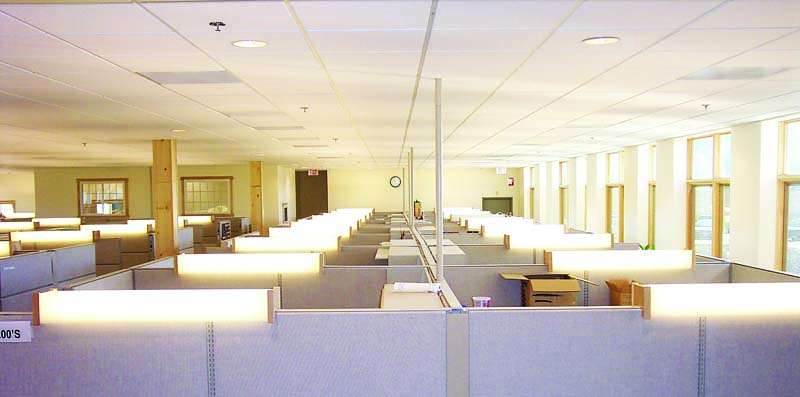
From the tour, both Curran and Organic Valley representatives came away struck by the powerful use of daylighting. The use of sunlight to illuminate building interiors is a key aspect of sustainable design, offsetting the use of artificial lighting and its associated energy consumption and cooling loads, which typically accounts for 30 to 40 percent of a building’s total energy use. Various studies also have shown a range of productivity and performance benefits associated with daylighting, including increased speed, improved mental function, reduced absenteeism, and increased sales.
To maximize daylighting, the Organic Valley headquarters face north and south, oriented 15 degrees off true north. Solar gains were also controlled by 129 windows from Pella, each 3×6 and glazed from 0 to 80 percent, depending on position. All windows on the south side have built-in blinds, as well.
The post-frame structure itself has a number of features that could be considered green. Standard steel roofing and siding gets major credit for its high recycled content. Steel cladding can gain even more green building credit by using paints that incorporate reflective pigments, although such coatings are not yet widely used on through-fastened panels predominant in rural building.
The standard Southern Yellow Pine frame helped matters, as the species is not considered endangered or exotic. None of the lumber was treated, so there are no concerns associated with arsenic or copper leaching into the soil.
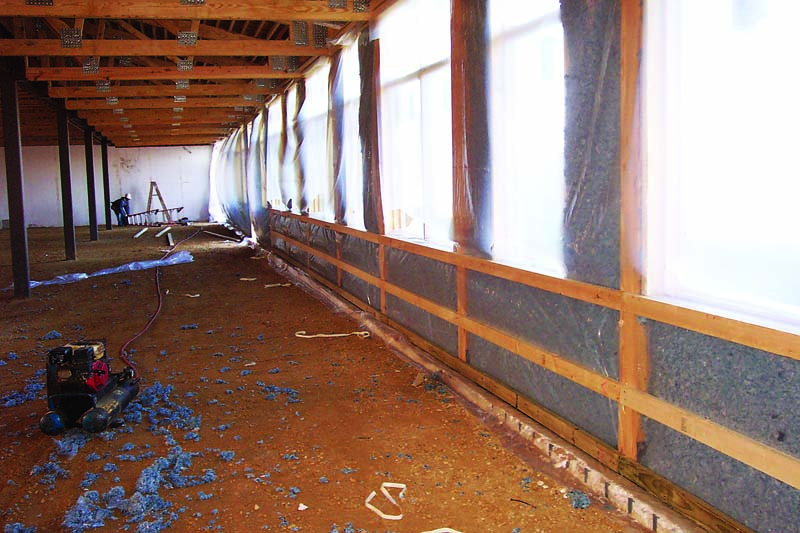
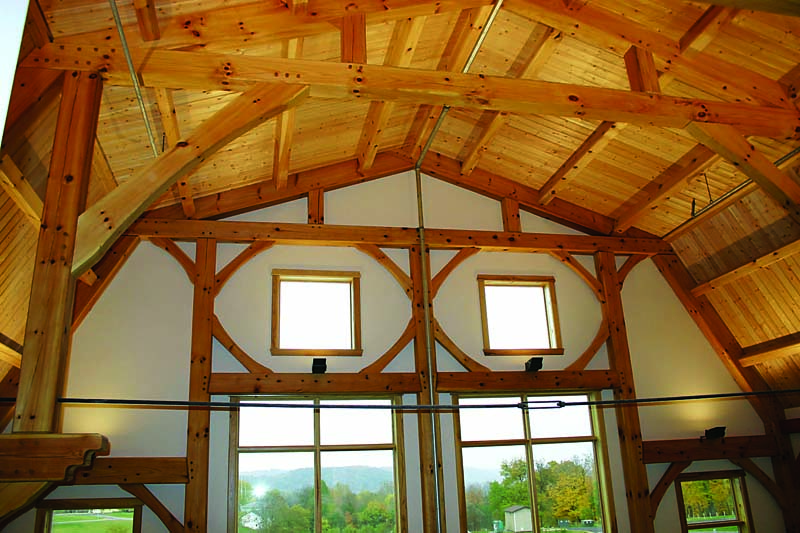
Several other materials familiar to cutting edge rural builders were used to make the building’s shell as energy efficient as possible. The foundation for the ground floor used insulating concrete forms from Eco-Block, which provided a continuous insulation barrier. A spectacular timber framed gambrel entryway, which used no metal fasteners, was sheathed with structural insulated panels from Heartland EPS.
During the project, crews from Morton and other subcontracting firms recycled all the construction waste from the project, separating it into five large containers.
Michael Schneider photos
Finishing Touches
With the big picture taken care of, the project team set out in search of interior finishing products that would aid the building’s energy efficiency while creating a pleasant work environment. Curran says it was not hard to find these products, once suppliers were given the proper criteria. “It took them awhile to find, but they all found them,” he says. “Probably the hardest thing I had to find was an architectural engineer that knew how to design the glass for daylighting. We found the one person, to my knowledge, in the Midwest who knew anything about it, and that’s why we went with Pella windows.”
Among the other subtle, yet effective, green touches:
◗ Ultra-Touch insulation from Bonded Logic uses recycled blue jean material.
◗ Drywall from National Gypsum uses recycled paper on the front and back.
◗ For interior paint, Eco-Spec from Benjamin Moore has low levels of odor and volatile organic compounds.
◗ Wood trim is locally obtained from sustainable Ash.
◗ The carpeting, Headlines by Patcraft, is 100 percent recyclable and low-VOC. Carpet glue is also low-VOC.
◗ Mars Clima Plus ceiling tile from USG is made from 72 percent recycled materials and has high light reflectance to support daylighting.
◗ Ceiling lighting, minimized to just navigational lighting over aisles, is highly efficient, using a 42-watt amalgam compact fluorescent bulb to create 3,200 lumens per fixture.
◗ Task lighting fixtures use one 13-watt fluorescent bulb.
◗ The cooling tower by Evapco uses glycol filled water and is freon-free.
◗ Urinals in men’s restrooms are water-free.
◗ The center core of each floor is the same, consolidating mechanicals to keep infrastructure together.
And that’s just on the inside. Organic Valley offers preferred “eco-parking” spaces for employees who carpool, ride bicycles or motorcycles, or drive cars that get more than 30 miles per gallon or use alternative fuel (downstairs showers are available for sweaty bicyclists). A mile-long nature trail, athletic field, and employee gardens help work workers relax while preserving the surrounding land.
A Green Future
The end result: a 49,210-square foot building built for $4.5 million. Cost per square foot: $91, including furnishings. Not a bad deal, considering the building’s many features that will control energy costs well into the future. The Organic Valley headquarters serves as a prime example that building with environmental responsibility in mind does not necessarily need to cost more. Curran says that perception is a major hurdle rural builders must overcome.
“Why isn’t there more green building in our industry?” he says, repeating a question. “Two things. First, a lack of knowledge about products — (builders) don’t know how to source it. Second, there’s a misconception out there that it’s going to cost them more to build, and most rural builders are afraid of price more than anything else. We proved all those things wrong.”
People who tour the building continue to have their preconceptions proven wrong on a daily basis. Michael Schneider, Organic Valley’s facilities project coordinator, says the organization guides at least one tour per day, leading interested builders, farmers, architects, and community members around its jewel on top of a hill.
“Are we surprised that we were able to accomplish our goals with a post-frame building?” Schneider says. “No, we knew all along this was going to fit our needs, so we weren’t surprised. Are other people surprised? The answer would most certainly be yes.
“Most people can’t believe we built an office building out of what is essentially a pole barn. Most people can’t believe we did it for just over $90 per square foot. Most people can’t believe how nice it is in here, how happy our people are.”
And why wouldn’t they be? At its heart, Schneider says, green building is a throwback to a simpler time, before new technologies emerged to “improve” building materials and techniques.
“There are a lot of parallels between organic food and green building,” Schneider says. “People view them as movements, a new wacky way of doing things, practiced by a small group that might be considered fringe or not normal. Organic farming is the way that it used to be, prior to 50 years ago, when people farmed land in a sustainable way and didn’t have chemicals to use as a crutch.
“The same thing goes for green building. When people built houses in the early part of the 20th century, they didn’t have all these nylon carpets and paints that are full of ammonia and formaldehyde. They used wool, or for resilient flooring they used linoleum. These were the materials that were available. These are the materials now considered alternative or green or different.
“I think it’s the new synthetic materials that are odd. We’ve really gone away from what nature has to offer, the way the world ought to be, and as a consequence we have sick building syndrome, air quality issues. Fifty years ago none of it existed.”
A perfect summation: green building is both the way of the past and the way of the future. As energy costs continue to rise, as employee wellness becomes a critical role for companies, and as environmental concerns continue to gain importance both socially and politically, savvy rural builders will look to incorporate green building products and techniques into their businesses.
“It’s a good concept, and it’s really picking up heads of steam,” says Curran. “Being against the environment is like being against motherhood and apple pie.”
It’s easy being green
Looking to take the green building lead in your area? If so, it pays to investigate the Leadership in Energy and Environmental Design program run by the U.S. Green Building Council. The USGBC established LEED in 2000 to provide a national standard for developing high-performance, sustainable buildings. LEED standards are currently available or under development for new commercial construction and major renovation projects, existing building operations, commercial interiors projects, core and shell projects, homes, and neighborhood development.
LEED provides a framework for assessing building performance and meeting sustainability goals. It emphasizes state of the art strategies for sustainable site development, water savings, energy efficiency, materials selection, and indoor environmental quality.
There are four levels of LEED certification: Platinum (52-plus points out of a possible 69), Gold (39-51 points), Silver (33-38 points), and Certified (26-32 points). Few buildings reach Platinum status, and reaching Gold is challenging, but Silver and Certified levels are very attainable.
John Mark Wood of Atlanta-based Holder Construction says that depending on project situations, many LEED points can be achieved for little or no cost, and almost every project scores some amount of LEED points by virtue of the base design. Wood disputes the fallacy that LEED certification comes with excessive cost. A recent study of 35 LEED projects indicates that LEED costs on average 2 percent more.
Wood breaks LEED points down into three categories: Type 1, which carry little or no cost premium, Type 2, which carry a cost premium but provide a short-term return on investment, and Type 3, which carry a cost premium with a long-term return on investment or no return.
Type 1 points cover such site dependent categories as site selection, public transportation access, and local/regional material sourcing, as well as non-site dependent categories like use of recycled content, waste management, low emitting materials, and innovation in design. Type 2 points include water efficient landscaping, optimizing energy performance, increased ventilation, and indoor chemical and pollutant control. Type 3 points include green power and daylighting/views.
Dan Curran’s Organic Valley project seems to be a shoe-in to achieve some level of LEED certification. Curran’s goal is to land between 45 and 50 points, reaching Gold status; Organic’s facilities project coordinator Michael Schneider hopes to hit Silver.
LEED certification comes with a cost, running into the thousands of dollars depending on the size of the project. Beyond the base goal of providing an energy efficient, employee friendly building, what is the appeal of LEED status for a building owner? “An ego thing, maybe,” says Schneider. “We wanted the healthiest building we could for our employees, with as little impact on the environment as possible, and I think we’ve accomplished that. Having it certified will maybe encourage more people to come and tour our building. It will put us on the map in the green building world.”
For more information on LEED, visit www.usgbc.org or call Curran at (608) 553-2680.