Fertilizer is a crucial component of many crop and livestock operations since soil fertility affects crop growth and yield in a greater way than any input other than water. As such, there is often a need to be able to store fertilizer on a farm. Whether your client needs to store synthetic fertilizers, manure, or compost, there is usually a need for some type of structure for storage, either short-term or long-term.
Reasons for Long-Term Storage
The fertilizer storage needs of any operation are likely to vary. If your client is close to railway and a grain elevator or agricultural cooperative, there might not be a need to store a lot of fertilizer, as it can be picked up or delivered easily on an as-needed basis. If your client’s operation is farther away or the operation is larger, however, there is likely a practical benefit in being able to store fertilizer in quantity until needed.
In addition, recent supply chain disruptions and market uncertainties (COVID, Ukraine conflict, and tariff increases) might lead some to have crucial inputs on hand in case of supply limitations and/or rapid price increases. Because there are good reasons to store fertilizer on site, there are some best practices for storage. As with anything being stored, there are some key factors to consider. In this case, it’s critical to maintain fertilizer quality, avoid environmental impacts (spills), and have ready access for use.

Keep Fertilizer Dry, Cool, and Out of the Sun
Maintaining the quality of stored fertilizer comes down to some simple guidelines: keep it dry, keep it cool, and keep it out of the sun. The impact of each of these factors depends on what’s stored and for how long. The shorter the storage, the less they matter, and the longer the storage, the more all three matter.
Because most operations aren’t likely to store fertilizer for more than a year (and usually for much less than that), keeping it dry and shaded may be sufficient, but don’t discount the value of keeping the temperature as consistent as possible. With that said, the simplest storage for short duration is a pile at the edge of a field where the material can be quickly loaded and spread. This method, while simple, doesn’t work for everything and is likely limited to fertilizers such as lime, gypsum, manure, and compost, and only for short duration (a week or so).
The major cause of fertilizer degradation and loss of nutrients is moisture. Most dry fertilizers are hygroscopic and will readily absorb moisture from the air. Temperature changes — where dry fertilizer ends up cooler than the air coming in — will exacerbate this situation. (Think dew forming on the fertilizer). With enough added moisture, dry fertilizers will clump, leading to poor spreading, and they can even dissolve and make a briny liquid that’s tough to contain and may be highly corrosive. In either case, a producer is left with a product that’s less effective than desired.
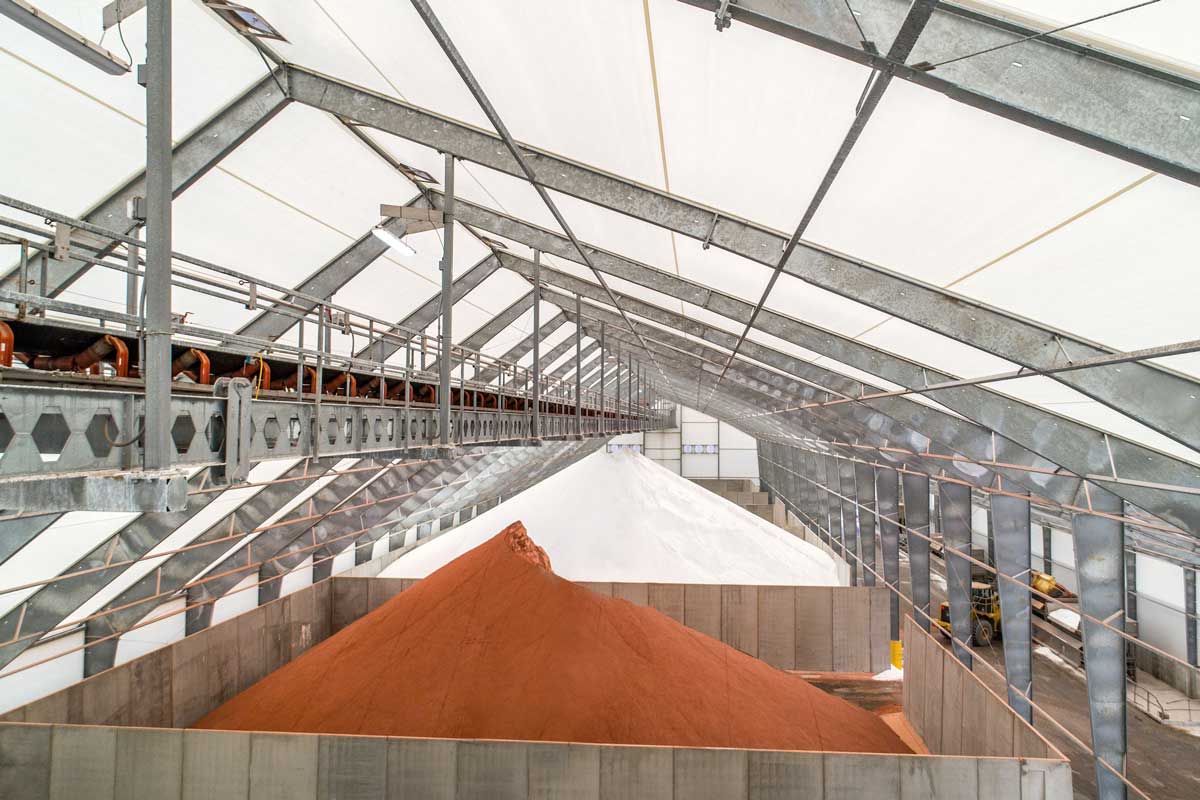
For these reasons, it’s critical that dry fertilizer is covered. While covering fertilizer with tarps can be a short-term solution, a better strategy might be storing it in a fabric-on-steel building or in a dedicated post-frame building. In either case, a concrete floor is critical, along with low walls to create bunks to separate materials and allow higher stacking of materials instead of just open piles. Access to these bunks from both sides may be desirable, with an alternative of having more bunks for the same materials. Either way works well to allow a producer to have a first-in, first-out approach for dry fertilizers. This will help avoid loss of quality of the oldest material and make sure that it all gets used.
The approach with storing dry manures and composts is similar, although the degree to which manure or compost needs to be sheltered from the elements is lessened, as these materials are spread with equipment that’s designed for that purpose. Manures and composts aren’t hygroscopic, and clumping won’t be a problem. However, it’s still good practice to keep dry manures and composts dry, as they’re bulky materials and are much heavier and harder to transport when damp. Additionally, keeping them dry reduces runoff.
For some specialty fertilizers, photodegradation can be an issue. While the large-scale use of coated, controlled-release fertilizers for field crops is limited, some clients may operate orchards, greenhouses, or grow high-value crops where the use of these fertilizers is more common. When storing these coated fertilizers, it’s critical to keep them out of the sun, as UV light degrades the coatings and will make these fertilizers less effective because they’ll lose their slow-release coating. Additionally, if constructing fertilizer storage for a golf course, lawn care service, or other turfgrass operation such as a sod farm, keeping the sun off the storage area will also be critical, as turf grass management often uses controlled-release fertilizers.
Storing Packaged Fertilizers
When storing packaged fertilizers rather than bulk fertilizers, there are some guidelines for storage. For container fertilizers (bags, totes, or other bulk containers), it’s prudent to keep them in their original labeled containers and to use secondary containers to contain any spills. It’s a good idea to use pallets or shelving to keep fertilizer off the ground to allow quick and efficient inspection of the containers. It’s far easier to spot leaks and spills when the containers are on pallets or shelves and will also help keep the materials out of any puddles on the ground or floor. Plus, they’re easier to move if they’re on pallets.
Fertilizer Security
A final note concerns fertilizer security. Fertilizer is an expensive material, which is an incentive for theft. In addition, some fertilizers have been used for nefarious purposes. Unfortunately, there have been high-profile cases, such as the tragic 1995 bombing of the Alfred P. Murrah Federal Building in Oklahoma City, in which the bomber used a Ryder truck packed with ammonium nitrate to kill 168 people, including 19 children.
For these reasons, federal and state regulations have been established to help safeguard fertilizers from both accidental explosion and deliberate use as a weapon. At the federal level, 29 CFR 1910.109 regulates storage of explosive materials, including ammonium nitrate. It requires fire protection, separation from combustible materials, and ventilation.
Other agencies can be involved, under the EPA’s EPCRA (Emergency Planning and Community Right-to-Know Act), the Clean Water Act, which is designed to prevent runoff and spills, and CFATS (Chemical Facility Anti-Terrorism Standards), which falls under the jurisdiction of the Department of Homeland Security (DHS). With the quantity of ammonium nitrate that some farms use, they can exceed the threshold amounts that can require federal reporting under CFATS.
Farmers may need a state fertilizer applicator license and may need to follow state laws for hazardous material reporting, locked storage, and signage, and have a plan in place with the local fire department and emergency planner.
Part of the planning for fertilizer storage requires a thorough understanding of the laws and guidelines that regulate it. More information is available from The Fertilizer Institute website (tfi.org) in its Safety & Security section and on the Responsible Ag website (responsibleag.org).
Conclusion
By listening to what types of fertilizers your client intends to store, as well as how much and for how long, you can help them meet their needs with an efficient and effective building or structure for their needs.
Fertilizer Storage with Tension Fabric Buildings
By Legacy Building Solutions www.legacybuildingsolutions.com
Corrosion can devastate fertilizer storage and distribution structures if they aren’t built to protect themselves against the caustic nature of the material they are housing. Tension fabric buildings are a popular facility option, since polyvinyl chloride (PVC) fabric cladding is naturally resistant to corrosive elements.
Because the framing structure is still made of metal, leading fabric building manufacturers have turned to solid I-beam framing to replace hollow-tube truss frames. This eliminates the chance of rust originating inside the frame, helping to greatly extend the longevity of a structure.
Hot-dip galvanizing is a common protective measure for I-beams and other steel members; however, because galvanizing’s intention to simply to slow down corrosion, and not prevent it, some suppliers instead use an epoxy coating method. With this approach, the structural beams are sandblasted, then painted with zinc, and finally are coated by epoxy layers — all of which combine to create a true barrier between corrosive fertilizer dust and the building’s steel frame.
Jacob Prater is a soil scientist and associate professor in Wisconsin. His passion is natural resource management along with the wise and effective use of those resources to improve human life.