
Originally Published as: Agricultural Accelerated Depreciation Under the OBBBA: What Rural Builders and Their Clients Need to Know About Buildings, Fixtures, and Farm Equipment
As a rural builder or ag-focused contractor, tax policy isn’t some abstract thing that only accountants worry about. When depreciation rules change, you hear about it almost immediately—from customers asking questions, to design tweaks mid-project, to last-minute decisions on what gets installed before year-end.
That’s precisely why the proposed One Big Beautiful Bill Act (OBBBA) has caught the attention of agricultural producers and the builders who serve them. Accelerated depreciation is back in the conversation, especially when it comes to farm buildings and the equipment and fixtures that are built into post-frame and metal structures.
The tricky part? The line between a “building,” a “permanently attached fixture,” and “equipment” isn’t always as clear as it should be. And while the IRS and tax advisors will always have the final say, builders who understand the basics are in a much better position to help clients plan smartly from the start—and avoid uncomfortable surprises once the building is up and the invoices are paid.
Knowing how these pieces generally fit together doesn’t make you a tax expert—but it does make you a better partner to your customer.
Accelerated Depreciation: A Refresher for Agricultural Construction
Accelerated depreciation allows qualifying businesses to recover the cost of capital investments faster than under a standard straight-line depreciation schedule. In agriculture, this typically intersects with:
- MACRS (Modified Accelerated Cost Recovery System)
- Bonus depreciation (where applicable)
- Section 179 expensing, subject to annual limits and eligibility rules
Historically, agricultural producers have been able to depreciate many types of equipment and certain building components over shortened recovery periods—provided the assets meet specific criteria related to use, attachment, and function.
The OBBBA, as proposed, reinforces congressional intent to encourage capital investment in domestic production, including agriculture. That makes the classification of building components more important than ever.
The Big Question: What Counts as the Building—and What Doesn’t?
For depreciation purposes, the IRS generally distinguishes between:
- The building structure itself
- Structural components
- Tangible personal property
- Land improvements
Accelerated depreciation is typically more favorable for items classified as tangible personal property or qualifying land improvements than for the building shell.
For rural builders, this distinction often comes down to fixtures and permanently attached components.
Fixtures Permanently Attached to Agricultural Buildings
A fixture does not automatically become ineligible for accelerated depreciation simply because it is bolted, wired, or plumbed into a structure. Instead, classification hinges on function, not just attachment.
Key considerations include:
- Does the item primarily serve the business operation, or the building itself?
- Would it still be useful if the building’s use changed?
- Is it specialized for agricultural production?
Under long-standing IRS guidance and case law, many fixtures permanently attached to agricultural buildings may still qualify as depreciable equipment rather than structural components.
Fans, Waterers, and Real-World Examples
HVLS Fans (High Velocity Low Speed Fans)
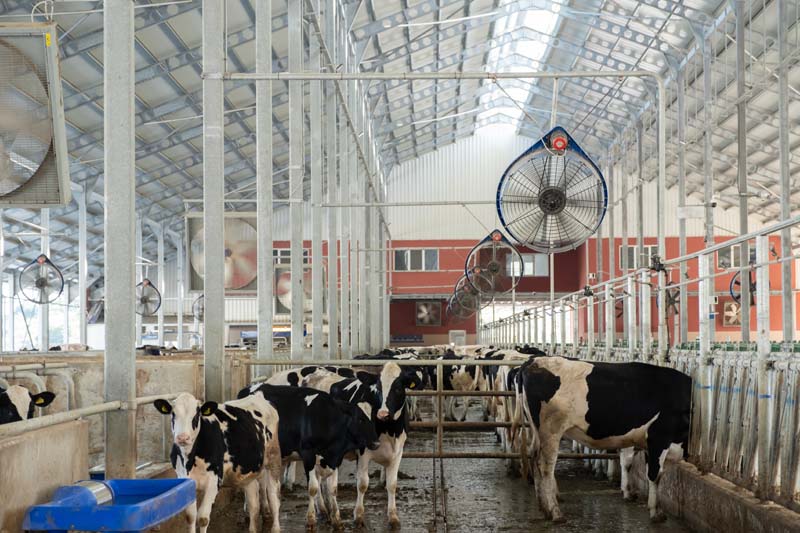
Large-diameter fans used in livestock barns, riding arenas, or poultry houses are a frequent point of confusion.
In many agricultural applications, HVLS fans are considered equipment used directly in production—supporting animal health, ventilation, and environmental control.
Waterers and Livestock Watering Systems
Livestock waterers that are plumbed into concrete pads or foundation walls raise similar questions.
Generally speaking:
- Waterers explicitly designed for livestock use
- Not integral to the building’s structural integrity
- Removable or replaceable without damaging the structure …are commonly classified as equipment rather than building components. Even when connected to underground utilities, these systems often fall under shorter recovery periods than the barn or shelter itself.
However, related infrastructure—such as buried water lines or concrete work extending beyond the immediate equipment footprint—may be treated differently.
Peripheral Fixtures and Components: Where Builders Must Be Careful
Peripheral components can be depreciable, but not all qualify equally. Items often evaluated separately include:
- Electrical systems serving specific equipment
- Plumbing dedicated to production use
- Control panels, sensors, and automation systems
- Specialized lighting for animal or crop production
If these systems are dedicated to equipment or production processes, they may qualify for accelerated depreciation. If they serve the general building (lighting, walkways, offices, or non-production areas), they are more likely to be classified as structural components.
This distinction underscores why how a building is designed and documented matters. Builders who clearly define systems as production-related—rather than general-purpose—can materially affect a client’s tax outcome.
Post-Frame and Metal Buildings: A Strategic Advantage
Post-frame and metal agricultural buildings often lend themselves well to favorable depreciation treatment because they are:
- Highly modular
- Equipment-centric by design
- Built around production workflows rather than finished interiors
When paired with clear construction documentation, these structures can make it easier for tax professionals to allocate costs between the building shell and qualifying equipment or fixtures.
For builders, this presents an opportunity—not to give tax advice—but to collaborate early with owners, accountants, and lenders during the design phase.
What Rural Builders Should Tell Clients (and What They Shouldn’t)
Builders should avoid definitive tax claims, but they can responsibly communicate that:
- Many permanently attached agricultural fixtures may qualify for accelerated depreciation.
- Classification depends on function, not just attachment.
- Cost segregation and proper documentation are critical.
- Final determinations rest with tax professionals and IRS guidance.
The OBBBA’s emphasis on domestic production investment makes these conversations more timely—but also more nuanced.
Bottom Line
Accelerated depreciation remains one of the most powerful financial tools available to agricultural producers—and one of the most misunderstood. As legislation like the OBBBA brings renewed focus to capital investment incentives, rural builders are on the front lines of implementation.
Understanding how fixtures, fans, waterers, and peripheral systems are commonly treated can help builders ask better questions, design smarter buildings, and add tangible value for their clients—long before the tax return is filed.
As always, builders and owners should consult qualified tax professionals for asset classification and depreciation elections.
The Builder’s Job (in simple terms)
Builders aren’t tax professionals
But builders can:
- Say what each thing does
- Keep costs separate
- Write things down clearly
That helps the tax professionals decide what counts faster.
The One Big Rule
Builders should say:
- “This might count faster. Ask your accountant.”
Builders should never say:
“This definitely counts.”
Bottom Line
- Buildings = slow
- Farm-working stuff = fast
- Bolts don’t matter
- Purpose matters
If it helps animals, crops, or production, it often gets counted faster—even if it’s screwed to the wall.
Here’s a safe, repeatable, one-paragraph explainer builders can use with customers without stepping into tax-advice territory:
“I’m not a tax advisor, but in general, the building itself—posts, walls, and roof—usually depreciates slowly, while equipment that helps your farm operate often depreciates faster. Even if something is permanently attached, like large ventilation fans, livestock waterers, or production-related systems, it may still be treated as equipment because of what it does, not how it’s attached. The key is how each item functions in your operation, and that’s something your accountant or tax professional will ultimately decide. Our job as the builder is to clearly document what’s installed and what it’s used for so they have the information they need.”
Checklist: Supporting Accelerated Depreciation Without Giving Tax Advice
Rural builders play a key role in how agricultural assets are classified for depreciation. While final determinations rest with tax professionals, the following best practices can help owners and advisors evaluate eligibility under the accelerated depreciation rules of the OBBBA and existing IRS guidance.
During Design & Planning
☐ Clarify the building’s primary use. Livestock housing, equipment storage, processing, or mixed-use facilities may be treated differently for depreciation.
☐ Identify production-related systems early. Note which components directly support animal health, crop production, or operational efficiency.
☐ Discuss equipment-heavy design options. Post-frame and metal buildings often allow clearer separation between structure and equipment.
During Construction
☐ Itemize invoices and contracts. Separate line items for equipment, fixtures, and specialty systems are critical for later classification.
☐ Document dedicated systems. Electrical, plumbing, and mechanical systems serving specific equipment should be clearly identified as such.
☐ Note method of attachment—but don’t rely on it alone. Permanently attached does not automatically mean “structural component.”
Common Items to Flag for Review
☐ HVLS fans used for livestock comfort or ventilation
☐ Livestock waterers (e.g., Ritchie waterers) and associated pads or mounts
☐ Specialized lighting for animal or crop production
☐ Environmental controls, sensors, and automation systems
☐ Feed, watering, or manure-handling equipment integrated into the building
After Project Completion
☐ Provide as-built drawings and system descriptions. These help tax professionals understand how assets function within the operation.
☐ Encourage consultation with a tax advisor or cost segregation specialist
Especially on larger projects or multi-use facilities.
☐ Avoid making depreciation promises. Use language such as “may qualify” or “commonly treated as,” not guarantees.
Builder Best Practice
☐ Position yourself as a documentation partner—not a tax authority. Builders who help clients organize information add value without assuming liability.
The Super Simple Version
What is accelerated depreciation?
- It means farm owners can count the costs of the things they buy faster when they file their taxes.
- Faster counting = less tax now, which helps cash flow.
What counts?
The government likes it when farmers buy things that help them farm.
So things that:
- Help animals stay healthy
- Help crops grow
- Help the farm run better
…often get counted faster than the building itself.
What about the building?
- The building shell (walls, roof, posts) is slow.
- It gets counted over a long time.
- But many things inside the building are not really the building—even if they’re bolted on.
“If it’s bolted down, is it part of the building?”
- Nope. Bolts don’t decide.
- What it does decides.
Ask this:
- Is it there to help the farm work, or
- Is it there just to be a building?
Do Big Fans count?
Usually, yes.
Big fans in barns or arenas:
- Help animals stay cool
- Keep air moving
- Help production
Even though they’re attached, they’re doing a job, not holding the building up.
So, they’re often treated like equipment rather than part of the building.
Do Rtchie waterers count?
Usually, yes.
Livestock waterers:
- They are made just for animals
- Could be replaced without tearing down the barn
- Help animals eat and drink properly
That makes them more like farm tools than walls or floors.
What about wires, pipes, and controls?
If the wires or pipes are:
- Just for that fan, waterer, or feeding system
- They often get counted faster, too. If they’re for:
- Lights in hallways
- Offices
- General use
- That’s usually part of the building.