For decades, the storage unit rental process was slow and cumbersome. Customers had to meet facility staff in person to sign lease contracts before they could move in. The staff also had to regularly patrol the facilities to lock delinquent customers out and unlock them when they paid. Over the last few years, however, the situation has changed. Storage units can now be accessed remotely through smart locks, and the demand for these locks is growing.
“Smart locks are quickly becoming an industry standard for operators looking to have long-term growth, facility differentiation, and operational efficiency,” said Nick Noethe, Passport Locking Solution representative. “Some key benefits to having smart locks at a facility include remote management, enhanced security, keyless entry, operational efficiency, and higher revenue potential.
“Smart lock adoption continues to grow and is expected to reach 60% of facilities by end of 2025,” Noethe added. “Based on a recent study, it was determined that 92% of owners, operators, and managers believe that new technology will enhance their competitiveness and operational efficiency at their facility.”
Early versions of smart storage locks were available as early as 2007, but the industry faced technical and logistical challenges with hardwired systems, installation, and cost. A number of companies have overcome those initial hurdles with wireless options, streamlined installation of locks or pre-installed locks, and lower costs, which has promoted wider adoption.
The decreasing cost of smart locks and growing demand from the digitally native younger generation is expected to translate into exponential growth of smart locks in both new storage facility construction and for retrofitting locks in pre-existing facilities. In many cases, smart lock companies license storage facility builders to install and program their locks, which can provide the builders with an additional revenue stream.
For both facility owners and customers, the technology offers many advantages over traditional hasps and padlocks.
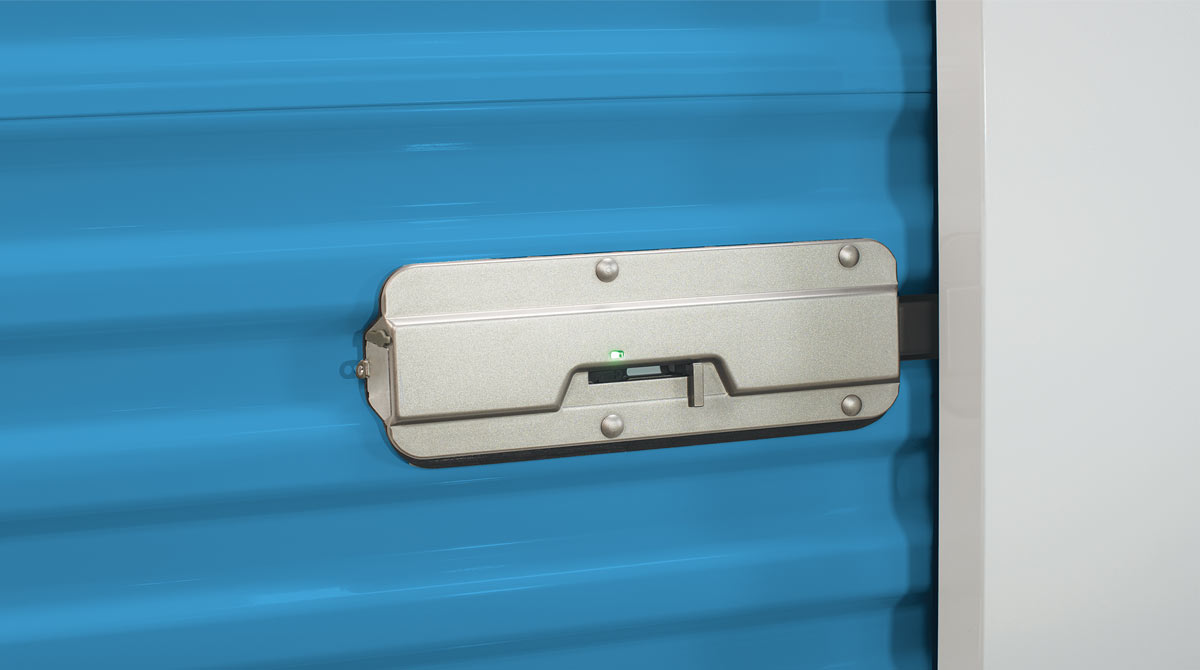
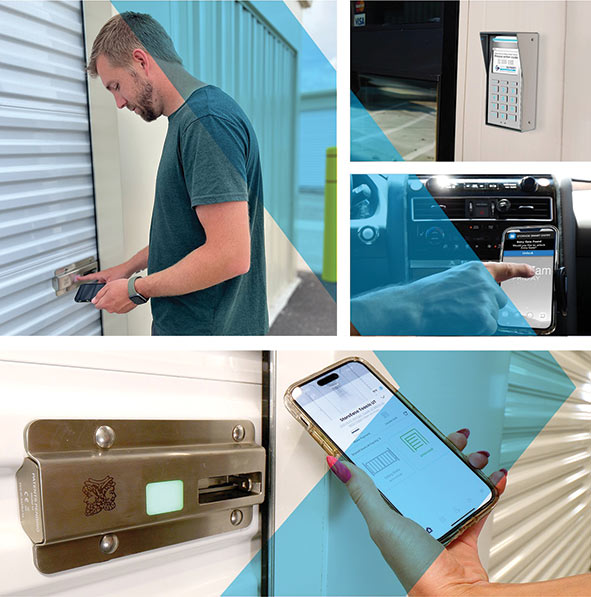
A Passport smart lock secures this Trac-Rite storage unit door. Trac-Rite has partnered with Passport, powered by Onity, a leading smart lock company with proven technology. Its locks are used not only on storage units but in other applications as well, in more than 30,000 properties in over 2,000 cities across seven continents. Smart locks allow storage facility customers and facility managers alike much more convenience than traditional padlocks.
Smart Lock Benefits for Customers
• Customers don’t need to visit a storage facility office or meet an owner or manager at the storage unit to sign a storage unit lease. A lease can be created and paid for online at any time so customers can begin a move-in within minutes.
• Renters can lock and unlock their units with a smartphone, so they don’t need to worry about forgetting or losing a physical key.
• Users can share access via digital permissions with family, friends, movers, employees, and others, and can grant or revoke access instantly.
• Renters can view access data online 24/7, so they know who is in their unit and when.
• A smart lock can improve security, as it has no padlock to cut off, and it offers entry and usage data for remote monitoring. Data points to better security. According to Janus International’s website, the company says that “[Facility] operators have reported 95%+ fewer break-in claims on smart units vs. traditional.”
Smart Lock Benefits for Facility Owners
• Smart access allows storage facility staff contactless lease management. Because staff don’t need to be on site, their time can be optimized for marketing and contracting leases to maximize profits.
• Based on customer demographics and demand, facility owners may be able to charge premium rates for units equipped with smart locks.
• Facility owners and managers can remotely overlock (lock out) delinquent customers and release the overlocks immediately after payment is made.
• Smart access allows business scalability. Because owners aren’t tied to a physical location, they can manage multiple sites, even while on vacation in a different state.
• Smart access provides detailed audit logs to analyze customer behavior. Audit logs identify storage access information, such as when units have been unlocked and by whom. If items are stolen from a unit, the audit can determine who had access during the time in question. The data can also provide insight into how renters are using the storage units. When renters remain in their unit for long periods, that may suggest that they’re attempting to sleep or live in their units or are possibly surveying other units for potential attempted break-in.
• Digital management allows staff to analyze usage patterns to identify when price increases might be feasible. An increase in the frequency of customer access to their units may indicate that the leases have enough value to them that they may be willing to accept a price increase.
The Transition from Traditional Locks to Smart Locks
Storage facility owners don’t have to offer an all-or-nothing option for digital versus traditional locks. They can provide a mix of digital and conventional locks within a single facility to match market demand. For example, 50% of units could be equipped with digital latches, and 50% with conventional padlock latches, and that mix can be adjusted as demand changes.
Leading Companies in Smart Locks for Storage Facilities
A common business model in the storage facility smart lock market is for roll-up door manufacturers to partner with large, well-known smart lock companies because the technology required is highly advanced and specialized, and the research and development takes years and a huge amount of investment.
The following are the most common roll-up door/smart lock partnerships.
Trac-Rite Passport Lock powered by Onity
Trac-Rite, based in Sun Prairie, Wisconsin, has been in business since 1981 and is a leading manufacturer of roll-up doors.
Onity is headquartered in Salem, Oregon. The company is more than 80 years old, and its locks are used in more than 30,000 properties in over 2,000 cities across seven continents.
Trac-Rite uses Onity’s Passport locks. “The Passport locks operate wirelessly using a lithium battery and Bluetooth connection to a tenant’s smartphone. No active Wi-Fi or network needed to access the unit,” said Noethe.
Trac-Rite doors are designed to work together with Passport smart locks to provide maximum security. “As an industry leader in roll-up door manufacturing, Trac-Rite designs doors with durable corrugated steel construction, precision-fit guide tracks, and reinforced door edges — all of which provide a strong foundation for integrating Passport smart locks,” Noethe added. “The tight tolerances and secure fit reduce pry points and prevent tampering, while the Passport system adds encrypted access control and real-time activity monitoring. Together, they deliver a robust, high-security solution built for today’s self-storage demands.”
SteelBlue Smart Latches powered by PTI Security Systems
SteelBlue Building Components was founded in 2021 and is headquartered in Pittsburgh, Pennsylvania.
PTI Security Technology is owned by the global company ASSA ABLOY, headquartered in Stockholm, Sweden. ASSA ABLOY has more than 61,000 employees and operates in over 70 countries.
SteelBlue offers two smart lock options: ProEdge and DoorBoss.
ProEdge is a smartphone-accessible lock. DoorBoss, on the other hand, is an option for those who don’t want to use a smartphone to access to their unit. DoorBoss users enter a PIN code at the facility gate, which then opens the lock on their unit. When leaving, users enter the PIN code again to relock the unit.
Nokē Smart Entry by Janus International
Janus International, founded in 2002 and headquartered in Temple, Georgia, has nearly 400,000 of their Nokē smart devices installed in self-storage facilities globally. The company offers two smart door lock options: Nokē ONE and Nokē Ion. Nokē ONE is a smartphone accessible lock mounted to the outside of the storage unit door. Locks can be retrofitted on doors in the field or shipped preinstalled on Janus doors.
Noke Ion also provides smartphone access, but this solution fits on the inside track of the door. It operates using a low-voltage, hardwired system with battery backup. It allows an upgraded addition of motion sensors and LED lights.
“Janus International is unique in that we provide a battery-powered smart door lock solution (Nokē ONE), a hardwired smart door lock solution (Nokē Ion), and smart entry control devices (Nokē Pad and Nokē Screen) for facility entrances. It’s a complete smart security solution,” said Christine DeBord, Janus International Chief Commercial Officer. “We’re also the only smart lock manufacturer to provide in-house project management and installation for our smart locking systems.”
Open Tech Alliance INSOMNIAC SmartLock
Open Tech Alliance is a technology company that provides automation, call center, and online auction services for the self-storage industry. It was founded in 2003 and is headquartered in Phoenix, Arizona.
It offers three INSOMNIAC SmartLock models: O, R, and S. Two of the locks can be used on most existing roll-up doors, so they’re not limited to a particular roll-up door brand. However, in April 2025, Open Tech Alliance announced that SteelBlue Building Components had entered a partnership to provide pre-punched doors for seamless installation of its locks. Pre-existing roll-up doors can be retrofitted with the locks, but it requires the holes to be drilled accurately, which can create some alignment challenges if not done carefully.
SmartLock O works with existing tenant locks and controls vacant and delinquent units without changing the tenant’s experience with keypad or Bluetooth access.
SmartLock R and SmartLock S provide both keypad and mobile access to the tenant through the Storage Genie app, automating unit access and security.
SmartLock R and SmartLock O are retrofitted over existing door hasps. SmartLock S completely replaces the hasp.
Conclusion
For so many years, the self-storage process was unwieldy and limiting, but with the advances in remote lock technology, facility operators and customers can take advantage of its greatly increased speed and convenience. As the digitally native population grows and costs decrease, the trend is bound to accelerate, unlocking limitless potential. RB