Originally published as: Built for the Cow First: Inside the decisions, details, and dollars that shape a
modern freestall dairy barn — from first drawings to first milking
A dairy barn is not a building that happens to hold cows. It is a production system — a facility engineered around the biology and behavior of the animal that drives the operation’s entire revenue stream. Every decision a builder makes, from slab thickness to stall width to the placement of a water tank, either supports milk output or quietly works against it. Get it right and the barn performs for 30 years. Get it wrong and the callbacks start before the first winter is out.
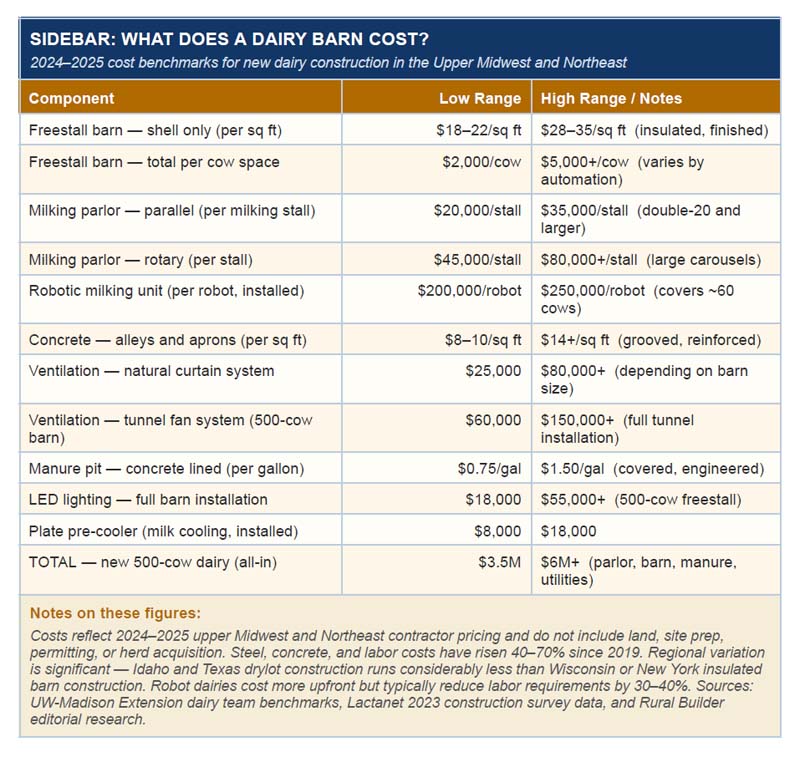
This article examines how experienced dairy barn builders approach a 500-cow freestall facility: the structural and systems decisions that define the building type, the design challenges that consistently trip up first-time dairy contractors, and the cost benchmarks that help producers and builders align expectations before the first nail goes in.
The audience for this piece is builders — contractors who may be doing their first or fifth dairy project and want a clear-eyed picture of what this building type demands. Dairy construction rewards specialized knowledge. The producers who build these facilities know it, and they ask hard questions before they sign a contract.
“A dairy barn has to work for the cow first. Everything else — cost, aesthetics, convenience — comes second.”
Start with the Animal
The foundation of any dairy barn design is the animal itself. A modern Holstein milking cow weighs approximately 1,400 pounds, drinks 30 to 50 gallons of water per day, produces 80 to 100 pounds of manure and urine daily, and requires 16 or more hours of light exposure to sustain peak milk production. She is a biological system with exacting needs — and a barn that meets those needs will outperform one that doesn’t in milk per cow, reproductive efficiency, and herd longevity.
That sounds obvious. In practice, it gets complicated when budget pressure pushes stall dimensions toward the minimum, when ventilation gets value-engineered down, or when the parlor is sized for the herd as it exists today rather than the herd the producer intends to milk in five years. Experienced dairy builders have seen every one of these trade-offs produce expensive regret. The builder’s job is to help the producer understand the consequences before the concrete is poured.
Freestall Design: Where Cow Comfort Begins
Current university extension guidelines — drawn from decades of production research — are more demanding on stall dimensions than the standards many older barns were built to. Stalls sized adequately in the 1990s are now understood to reduce lying time, increase the time cows spend standing on concrete, and contribute to lameness, which is among the most economically damaging conditions in a dairy herd. Lameness costs an affected cow an estimated $300 to $500 per lactation in lost production, treatment, and early culling.
For a 500-cow herd, that number compounds fast. A builder who persuades a producer to invest in properly sized stalls, correct lunge space, and quality bedding infrastructure is not upselling — he is protecting the client’s investment.
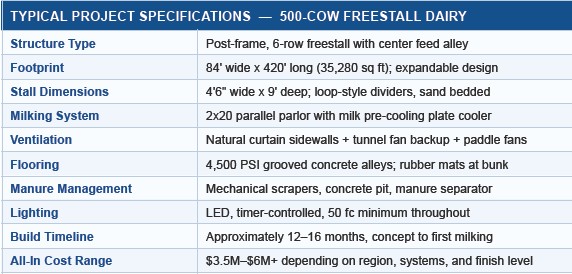
Stall width: 4’6” minimum for mature Holsteins; 4’8” preferred on newer construction
Stall depth (head-to-head): 9’ clear, with 8’6” lunge space above the neck rail
Brisket board: Set at 68” from curb; prevents forward creep without restricting lying movement
Rear curb: 10” maximum height — lower than traditional designs to ease cow entry and exit
Bedding: Sand is the gold standard for cow comfort and mastitis control; requires dedicated storage and delivery infrastructure
Alley mats: Rubber mats at feed bunk for 10’ depth; cows standing on concrete at the bunk are at elevated lameness risk
Ventilation: The System That Drives or Kills Performance
Ask experienced dairy producers what they would do differently if they built again. Ventilation comes up repeatedly. A barn that cannot move air in July is a barn that suppresses milk production — measurably, immediately, and compoundingly as temperature and humidity rise. Heat stress in dairy cows begins at approximately 68 degrees Fahrenheit. Above that threshold, dry matter intake drops, milk production falls, and reproductive performance declines sharply. The losses accumulate across the herd every day conditions persist.
Natural cross-ventilation — continuous open ridge and adjustable sidewall curtains — is the primary system on most Upper Midwest and Northeast dairy barns. For barn widths up to approximately 70 feet, natural ventilation can maintain adequate summer airflow. Beyond that width, supplemental systems are necessary.
Tunnel Ventilation as Backup
A tunnel ventilation backup is specified on most new 80-foot-plus barns: a bank of large-diameter fans at one end wall, inlet louvers at the opposite end, creating a designed air velocity of 400 feet per minute or better through the cow zone when conditions require full activation. Variable-speed fans allow the system to modulate through a range of conditions rather than switching between full-on and off.
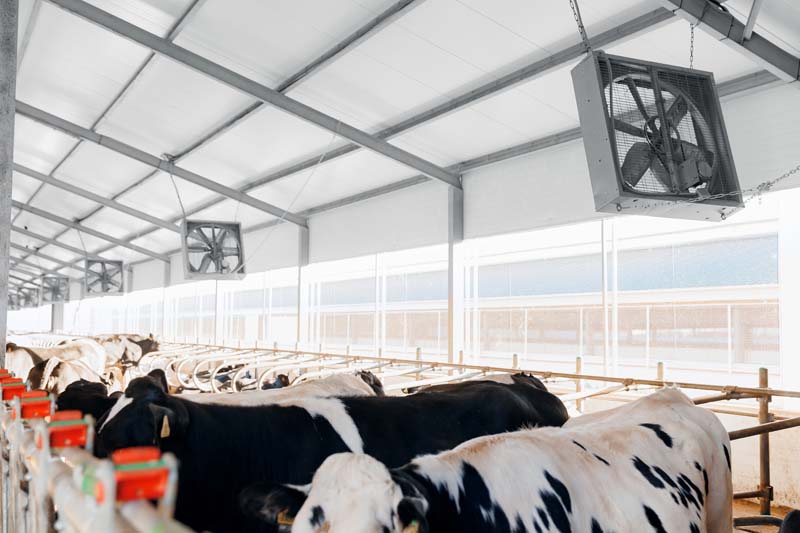
Overhead paddle fans — 72-inch diameter on 40-foot centers — run continuously over stall rows from late spring through early fall. Research consistently shows that fans delivering continuous airflow directly to the resting zone reduce heat stress more effectively than tunnel ventilation alone during moderate heat events, which are more frequent than the extreme events that require full tunnel activation.
Winter Ventilation: The Harder Problem
Winter ventilation on a northern dairy barn is the design problem that rarely gets adequate attention in pre-construction conversations. The challenge is maintaining air quality — removing moisture, ammonia, and carbon dioxide from a building occupied by 500 large animals — without creating cold drafts that compromise cow comfort or increase the energy cost of body temperature maintenance.
The practical solution is an automated curtain controller that closes sidewalls progressively as temperatures drop, maintaining a minimum air exchange rate through the ridge vent opening alone at the coldest settings. The controller’s temperature setpoints are specific to the climate zone. A Wisconsin barn and a Virginia barn of identical dimensions will have different winter ventilation management requirements — a detail that matters when the building contractor is specifying the control system.
Concrete: The Most Critical Material in the Building
In a dairy barn, concrete is everywhere and it has to perform in one of agriculture’s most punishing environments. Manure acids, daily pressure washing, mechanical scraper blade traffic, heavy livestock, freeze-thaw cycles, and cleaning chemicals all attack concrete surfaces continuously. Failures — cracking, spalling, surface deterioration — translate directly into hoof problems, which translate into production losses and culled animals.
The specification for dairy barn concrete is not the same as for a general agricultural building. A 5-inch, air-entrained slab at 4,500 PSI minimum with a water-to-cement ratio below 0.45 is the baseline. Wire mesh and rebar in alley areas are standard. All concrete should be cured under blankets for a minimum of 7 days before any scraper or livestock traffic is allowed.
Groove Pattern and Traction
The surface texture of alley concrete directly affects lameness rates. Cows on slick floors alter their gait, reduce trips to feed and water, and are at elevated risk of slipping and injury. A diamond-groove pattern — 3/4-inch wide, 1/2-inch deep, on 4-inch centers at a 45-degree bias to the alley direction — provides traction in all directions of travel while remaining cleanable by scraper blade.
The feed apron, where cows stand during eating, is typically broom-finished and left ungrooved, with rubber mats providing the traction surface. Rough grooved concrete at the bunk face can abrade the softer sole tissue of cows that spend extended time standing at feed.
Slope and Drainage
Alley floors should slope toward manure channels at 2 percent — enough to direct wash water and liquid manure without creating a surface cows have difficulty walking on. Slopes steeper than 2.5 percent increase slipping risk and cow reluctance to move. Cross-slope in front of stalls should be minimal. Getting these grades right requires surveying and screeding care that costs real money to do properly and far more to fix after the fact.
The Milking Center: Where the Revenue Is Produced
The milking parlor is the revenue engine of the dairy operation. Cows that spend excessive time walking to and from the parlor, waiting in a crowded holding area, or moving through a slow milking system are cows that are not lying down, resting, and producing milk. Parlor efficiency has a direct and measurable effect on the productivity of the entire barn.
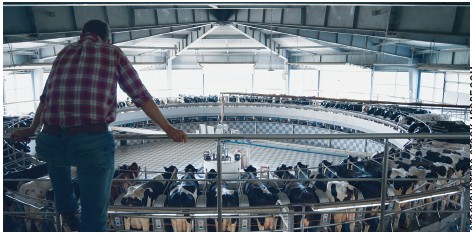
Parlor selection is primarily a function of herd size and labor availability. A 2×12 herringbone handles a 200-cow herd well. A 2×24 parallel begins to make sense above 400 cows. Rotary systems — where cows step onto a slowly rotating platform and step off when milking is complete — become cost-effective above 600 to 800 cows, offering throughput of 700 or more cows per hour with a single operator. The capital cost of a rotary is substantially higher than a parallel; the labor savings at large herd sizes typically justify it within a few years.
Support Infrastructure
The parlor building is only part of the milking center. The support infrastructure around it shapes operational efficiency as much as the parlor itself:
Holding area: Covered concrete pad for 20–25% of the milking herd; sprinklers and fans for heat abatement; crowd gate to move cows without labor
Covered return lane: One of the most frequently value-engineered items in dairy construction and one of the most frequently regretted. Cows returning uncovered in winter weather lose heat, track ice into alleys, and experience stress that affects subsequent production.
Milk pre-cooling: A plate cooler between the parlor and bulk tank pre-cools milk from approximately 100 degrees F to near groundwater temperature before refrigeration. The compressor savings pay back the cooler cost in 2–3 years at current energy prices.
CIP (clean-in-place) system: Automated chemical wash cycle for all milk contact surfaces. Hot water capacity must be sized for full CIP demand at each milking.
Employee facilities: Break room, restrooms, equipment storage. These are not extras on a dairy that requires around-the-clock labor; they affect staffing and retention.
Design Challenges and Builder Solutions
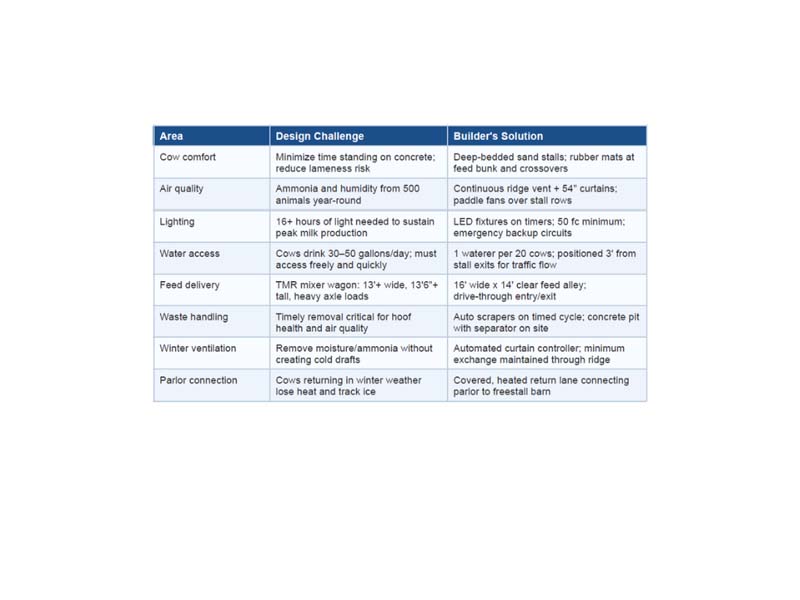
The following table documents the recurring design conflicts on dairy barn projects — the decisions that separate experienced dairy contractors from those learning on the client’s dollar.
Manure Management: Size Up, Not Down
A 500-cow dairy produces roughly 25,000 gallons of liquid manure per day. Manure management is not a peripheral consideration in a dairy barn — it is a central design constraint that affects alley geometry, floor slope, structural loading at the collection point, and the site plan for storage.
Mechanical alley scrapers on a timed cycle are standard on freestall barns of this size, pushing manure to a collection channel that drops to a concrete receiving pit. The pit should be sized for a minimum of 30 days of storage to provide flexibility during wet springs or frozen ground conditions that limit field application. Mechanical separators are increasingly common: they remove the solid fraction for composting or bedding reuse, reducing the liquid volume that goes to lagoon storage.
Manure system sizing is one of the areas where producers most consistently underinvest on first-build projects. The cost of building 20 percent more storage at time of construction is a fraction of the cost of adding it later — and in states with prescriptive nutrient management requirements, running out of storage is not just an inconvenience. It is a regulatory problem.
Builders entering the dairy space should also be aware that anaerobic digester projects — which capture methane from stored manure and convert it to pipeline-quality natural gas or on-farm electricity — are becoming more common on larger operations. These projects require coordination between barn contractor, digester installer, utility company, and state environmental regulators, and they shape barn design in ways that must be anticipated from the start.
Lighting: Chronically Underspecified
Photoperiod management — controlling the hours of light exposure cows receive — is one of the simplest and most cost-effective production tools available to a dairy producer. Research is consistent: maintaining 16 hours of light per day at a minimum of 50 foot-candles throughout the barn increases milk production by 8 to 10 percent compared to cows in naturally lit housing. The mechanism is hormonal; the results are reliably reproducible.
Despite this, lighting is among the most commonly underspecified systems in dairy barn construction. Fixtures are placed too high, spacing is too wide, and the measured illumination at cow level fails to meet the 50-fc threshold — not because the owner chose to underinvest, but because no one checked with a light meter before the ceiling was closed.
LED fixtures on timer-controlled circuits are the current standard. The timer allows the barn to maintain the 16-hour photoperiod regardless of season. A dry cow period of 8 hours of light per day can be managed in a separate section of the barn or a separate dry cow facility. Builders should confirm illumination levels with a meter at multiple locations before considering the lighting installation complete.
What to Ask Before You Bid
Dairy barn projects reward builders who ask detailed pre-bid questions. The answers shape the specification in ways that cannot be recovered after construction begins. Before bidding a dairy project, experienced contractors verify:
What is the largest piece of equipment that will enter this building, now and in 10 years? Spec the feed alley and door openings for growth.
Will the barn be heated? If so, specify insulated panels, a thermal break in the wall system, and a heating system sized for the building volume.
What is the cleaning protocol? Wet washdown environments require different materials and floor finishes than dry-scraped alleys.
Is three-phase electrical service available at the site? Parlor motors, ventilation fans, and refrigeration compressors typically require it.
What is the nutrient management plan? The manure storage system must satisfy state requirements for storage capacity and setback before a permit will be issued.
What is the herd size in 5 and 10 years? Design the barn for the future herd, even if construction is phased.
Who is the milking system supplier? Parlor dimensions must be coordinated with equipment specifications early — changes late in design are expensive.
Is an anaerobic digester or renewable energy system being considered? This affects manure system design, site layout, and utility connection requirements from day one.
“The most expensive dairy barn is the one you have to modify in year three because the original spec wasn’t built for how the farm actually operates.”
Final Thoughts for Builders
Dairy construction is among the most technically demanding segments of agricultural building. The producer who is building a 500-cow freestall barn has usually spent years preparing for it — working with extension educators, visiting other farms, consulting with nutritionists and veterinarians, and modeling the financials in detail. They arrive at the builder’s door with knowledge and expectations.
The builders who succeed in this space match that preparation. They understand why stall dimensions matter. They can talk intelligently about ventilation design and concrete specifications.
They know what questions to ask before the bid goes out and what decisions cannot wait until construction is underway.
The reward for that investment is a client relationship that tends to be long-term. Dairy producers who have a good experience with a contractor come back — for the next barn addition, the parlor expansion, the heifer facility, the equipment storage building. In agricultural construction, dairy is a demanding entry point. It is also one of the most durable.