Originally Published as: Track, Trolleys, and the Truth About Sliding Door Hardware: Not all sliding door hardware is created equally and picking the wrong track or trolley can cost you a lot more than a callback. From post-frame barns to commercial warehouses, equestrian facilities to rural retail, here’s what every builder needs to know.
Walk into any farm supply or building products showroom, and you’ll find an entire wall dedicated to sliding door hardware. Tracks and trolleys — sometimes called carriages — come in a dizzying range of profiles, gauges, coatings, and load ratings. For contractors and owner-builders, the sheer variety can be paralyzing.
The good news: once you understand a handful of key variables, matching the right hardware to the job becomes straightforward — whether you’re hanging a rough-sawn pine door on a hobby barn, outfitting a 200-foot dairy facility, rolling out a series of aisle doors in an equestrian center, or finishing a large-opening commercial warehouse. Sliding door hardware is not one-size-fits-all, but it is learnable.
This guide breaks down the differences in door track profiles, material grades, and trolley designs, and explains when each option makes sense across the full spectrum of rural and commercial building types.
Where Sliding Doors Show Up — and Why It Matters
Before diving into hardware specifics, it’s worth acknowledging how broad the universe of sliding door applications actually is. Each building type presents a different combination of door weight, use frequency, environmental exposure, and aesthetic expectation — and those variables drive hardware selection more than almost any other factor.
Post-frame agricultural buildings. The classic application: sliding doors on pole barns, machine sheds, hog confinements, dairy freestall barns, and commodity storage facilities. Door weights range from a few hundred pounds for a simple equipment passage to well over a thousand pounds for a paired steel-panel door on a large drive-through bay. Environments range from relatively benign (dry equipment storage) to severely corrosive (livestock confinement with constant ammonia and moisture).
Commercial and light industrial buildings. Metal-frame and tilt-up concrete buildings in rural markets increasingly use sliding doors on loading docks, shop bays, and storage areas. These applications often involve heavier door panels — insulated steel, hollow-metal, or aluminum — and high cycle counts from daily commercial use. Hardware must perform reliably under conditions that would exhaust residential-grade systems quickly.
Equestrian facilities. Horse barns present a unique combination of demands: doors that open and close dozens of times daily, an environment with bedding dust and manure moisture, animals that lean and push against closed doors, and owners who are acutely aware of aesthetics. Stall doors, wash rack entrances, and aisle doors in equestrian builds typically demand mid-grade to heavy-duty hardware with robust anti-jump retention and smooth, quiet operation.
Hobby barns and residential outbuildings. Backyard workshops, small livestock shelters, garden sheds, and residential garages with sliding doors are the lightest-duty end of the spectrum. Door weights are manageable, and cycle counts are low, but these customers are often hands-on DIYers who will install the hardware themselves and return for replacements if it fails early. Quality entry-level hardware with sealed bearings is appropriate here; cutting corners on grade rarely saves money in the long run.
Rural retail and agritourism buildings. Farm stores, event barns, wedding venues, and agritourism facilities use sliding doors heavily for both functional access and visual appeal. The barn-door aesthetic is a design asset in these settings, and hardware that looks industrial or cheap undercuts the brand. These applications often call for hardware that performs well and presents well — powder-coated black or galvanized-bright finishes that complement exposed-wood interiors.
Cold storage and specialty agricultural facilities. Refrigerated produce storage, grain handling facilities, and similar structures may use insulated sliding panels of substantial weight. Cold storage environments create condensation and freeze-thaw cycling that are particularly hard on hardware finishes and bearing seals. Specifying sealed-for-life bearings and hot-dip galvanized or stainless components is not optional in these settings — it’s the cost of the callback you’re trying to avoid.
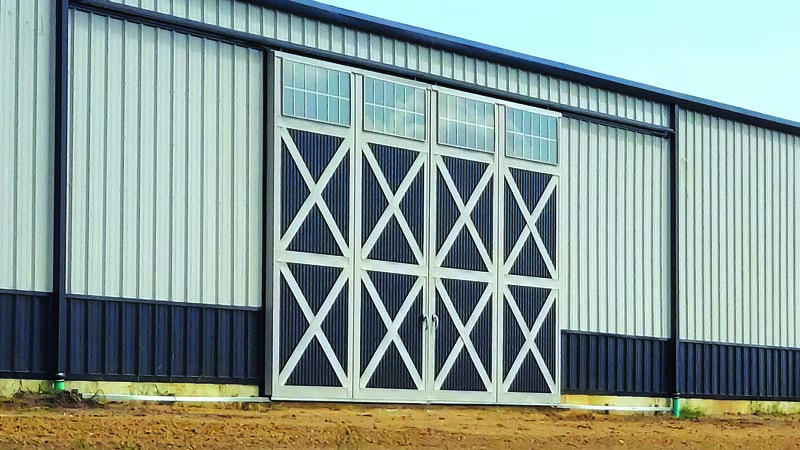
Courtesy of I-Beam Sliding Doors
Starting with the Track
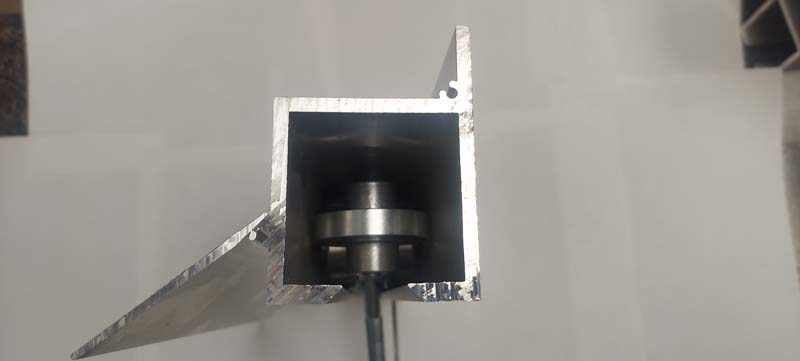
The track — also called the rail — is the horizontal beam from which the door hangs. It bears the full weight of the panel and guides every open-and-close cycle over the life of the building. Tracks are commonly manufactured from cold-rolled steel, galvanized steel, or stainless steel, and they are offered in several profiles.
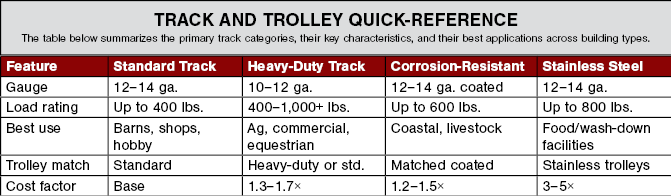
Standard barn track (I-beam or structural channel). The most common profile in rural construction, this track features a flat running surface on the bottom flange and a top flange that bolts to a header or fascia board. Available in 6-, 8-, and 10-foot sections that splice together for longer runs. Typical material gauge runs 12 to 14, which is adequate for most residential-grade sliding doors up to around 400 pounds.
Heavy-duty structural track. Purpose-built for commercial, equestrian, and working-farm applications, heavy-duty track uses thicker steel — often 10 to 12 gauge — and a deeper profile to resist flex under load. When you’re hanging a 10-foot-wide, two-inch-thick pine door, a powder-coated steel panel for a large equipment bay, or the aisle door on a 36-stall horse barn, this is the category you want. Some manufacturers test these systems to 800 or even 1,200 pounds of dynamic load.
Corrosion-resistant and specialty track. For livestock barns, coastal builds, cold storage facilities, or any environment with persistent moisture or aggressive airborne particulate, galvanized or electro-coated track extends service life dramatically. Stainless-steel track is the premium option for the harshest environments — food-processing facilities, seafood operations, or buildings subjected to frequent wash-downs — though its cost makes it difficult to justify for most standard agricultural and rural commercial applications.
Track length matters, too. Most sliding door systems specify a track run equal to one-and-a-half to two times the door width — enough for the panel to clear the opening completely while still distributing load across an adequate bearing length. Skimping on track run is one of the most common installation errors; it puts excessive stress on the last trolley and causes premature wear, whether the building is a hobby barn or a commercial processing facility.
Understanding Track Profiles in Detail
While the broad categories above cover most purchases, track profiles vary in subtle ways that affect trolley compatibility and overall system rigidity.
Bottom flange width. A wider running surface distributes the trolley’s wheel load over more steel, reducing point stress and extending track life. Heavier-rated tracks almost always feature wider flanges. In commercial applications where a door cycles repeatedly throughout the day, this difference is measurable in years of service life.
Web depth (the vertical portion between flanges). Deeper webs resist lateral flex, which becomes important on long track runs or when doors experience side-loading from wind. Commercial and equestrian facilities with wide openings — often 16 to 20 feet or more — benefit significantly from deeper-profile track.
Top flange configuration. Some tracks are designed to mount face-to-face with a header board; others feature offset or slotted flanges that allow height adjustment after installation. Adjustable systems are especially useful on older structures where headers may have settled unevenly, and on metal buildings where the girt or header tube may not sit perfectly plumb.
Mixing track profiles from different manufacturers or product lines is rarely a good idea. Trolley wheel width and bearing geometry are engineered to match specific running-surface dimensions; a mismatched combination can cause binding, accelerated wear, or in extreme cases, a door derailment. This is especially consequential in high-cycle commercial settings.
Trolleys: The Workhorse of the System
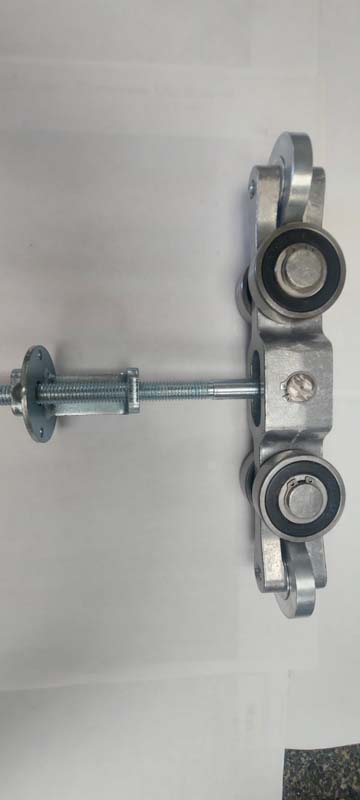
The trolley — sometimes called a carriage, hanger, or roller — is the wheeled assembly that rides the track and carries the door. Every sliding door has at least two trolleys, and heavy or extra-wide panels often use four. The differences between trolley types are significant across all building categories.
Fixed vs. adjustable trolleys. Fixed trolleys bolt directly to the door at a set height. Adjustable trolleys incorporate a threaded rod or bolt that lets the installer dial in the door height after hanging — a valuable feature when working with rough-sawn lumber doors, on sites where the track couldn’t be set perfectly level, or in renovation projects on existing structures that have settled. Most quality systems offer some degree of adjustment; how much varies by manufacturer and price point.
Wheel material and bearing type. Entry-level trolleys use plain steel wheels running directly on the track. Mid-grade trolleys incorporate sealed or shielded ball bearings, which reduce friction, carry more load, and extend service life. For the smoothest operation and best longevity in working-farm or high-cycle commercial environments, look for trolleys rated for grease-pack or sealed-for-life bearings. Cast-iron wheels are also available and are exceptionally durable, though heavier and best suited to heavier industrial applications.
Single-wheel vs. dual-wheel trolleys. Standard trolleys use a single wheel on each side of the track. Dual-wheel (tandem) trolleys have two wheels per side, doubling the contact area and load capacity. They’re the right choice for oversized doors, heavy steel panels, insulated commercial doors, or any application where the door weight approaches the top of the standard trolley’s rated capacity.
Anti-jump and retention features. Most trolleys include some form of track retention — a keeper plate, lip, or channel enclosure that prevents the wheel from jumping the track if the door is pushed laterally. In high-wind regions, livestock barns where animals can push against doors, equestrian aisles with active horses, and commercial facilities where forklifts or equipment may contact a door panel, robust retention features are not optional.
Load Ratings: Reading Them Correctly
Every track and trolley system carries a rated load capacity, but those numbers require some context. Manufacturer load ratings typically reflect static load — a door hanging still — not the dynamic forces generated when a door is opened hard, swings in wind, or is moved by a farm worker in a hurry. A reasonable rule of thumb used by experienced builders is to select hardware rated at 1.5 to 2 times the actual door weight.
Door weight is frequently underestimated. A 4-foot by 8-foot section of 2-inch-thick rough-sawn oak runs roughly 160 to 180 pounds. A similar-sized steel-skinned insulated panel can exceed 250 pounds. A large paired commercial door — two panels on a single header — can easily reach 800 to 1,000 pounds total. Equestrian aisle doors and wide commercial bay doors often surprise builders who haven’t weighed them before.
Track deflection is a related concern. Even adequately rated track will sag perceptibly on long runs if the header isn’t stiff enough to support it. Track manufacturers publish maximum span tables for unsupported lengths; following them is as important as matching load ratings. On commercial buildings and wide equestrian aisle openings, this means consulting span data before header materials are specified — not after the track is on the wall.
Galvanizing, Coating, and Finish Considerations
The environment a sliding door operates in determines the appropriate hardware finish more than almost any other variable. Rural and commercial buildings present an enormous range of conditions, and finish is a functional specification, not a cosmetic one.
Hot-dip galvanizing provides the most robust corrosion protection for steel track and trolleys. The zinc coating bonds metallurgically to the base steel and sacrifices itself preferentially, protecting the underlying metal even if the coating is scratched or abraded. Electro-galvanized or zinc-plated hardware offers a thinner coating that looks similar but provides substantially less protection. Read product specifications carefully and do not assume “galvanized” means hot-dip.
Powder-coated track and trolleys are increasingly common and provide excellent UV and moisture resistance, but the coating can chip at contact points over time. Some builders apply a wax or dry-lubricant treatment to the running surface of powder-coated track to reduce wear at the wheel interface. Powder coat is an especially good choice for agritourism, event barn, and rural retail applications where finish appearance matters.
Stainless steel hardware is the right call for food-processing facilities, seafood operations, wash-down environments, and similarly demanding applications. Its cost — often three to five times that of galvanized steel — is difficult to justify elsewhere, but in those settings, it is genuinely the only appropriate specification.
Livestock barns deserve special mention. Ammonia from manure is corrosive to many coatings and will attack bare steel hardware within a single season. Any building housing poultry, hogs, or dairy cattle should use, at minimum, hot-dip galvanized hardware throughout, with sealed bearings to protect internal components from airborne particulate.
Installation Tips That Make the Hardware Last
Even premium hardware fails prematurely when it’s installed carelessly. A few field practices make a disproportionate difference in long-term performance — and they apply regardless of building type.
Get the header right first. The header board or header assembly must be plumb, level, and stiff enough to carry the track and door load without flex. For wood-frame buildings, a minimum doubled 2×12 is common for residential barn doors; heavier applications may call for LVL beams or built-up lumber headers. In metal buildings, track typically mounts to a girt or purlin — confirm that member is adequately sized to carry the door load before track is ordered. No amount of quality hardware compensates for a bouncy header.
Use the right fasteners. Lag screws for track mounting should penetrate solid framing — not just sheathing or cladding — by at least 2.5 inches. In steel-frame buildings, track is typically bolted to a girt with through-bolts and backing plates. Never rely on sheet metal screws alone for track attachment. On commercial and equestrian buildings, hardware suppliers can provide pull-out load data for your fastener pattern — ask for it.
Set trolley spacing correctly. Trolleys are typically spaced at one-quarter and three-quarters of the door width, measured from the leading edge. This distributes the load evenly and minimizes racking as the door travels. On doors wider than 8 feet — common in commercial bays and equestrian aisles — four trolleys spaced at the quarter points are advisable.
Install a bottom guide. A floor-mounted or wall-mounted bottom guide controls lateral movement and prevents wind from blowing the bottom of the door outward. The guide should allow the door to swing slightly — within 1 to 2 inches — but resist sustained lateral force. On equestrian facilities and livestock barns, a robust floor guide is particularly important; animals will find and exploit any slack in the system.
Lubricate at installation and annually. Dry lubricants (PTFE-based sprays or wax sticks) are preferred over oil-based products on track running surfaces. Oil attracts dust, feed chaff, and grit — all of which accelerate abrasive wear. Sealed-bearing trolleys need little attention, but the running surface itself benefits from periodic treatment. For commercial and equestrian buildings with high cycle counts, a lubrication schedule is worth putting in the owner’s manual.
Matching Hardware Grade to Building Type
Hardware grade selection should follow a simple logic: match the specification to the harshest combination of door weight, cycle count, and environmental exposure the building will actually see. The matrix below is a useful starting point.
Entry-level hardware with sealed bearings. Appropriate for hobby barns, residential outbuildings, garden sheds, and low-cycle agricultural storage. The sealed bearings — which add only modest cost over plain-wheel systems — are worth specifying even here; they dramatically extend service life without requiring the owner to maintain them.
Mid-grade hardware with heavy-duty track. The right call for most working agricultural buildings: machinery storage, hay and commodity storage, small livestock facilities, and standard pole barns. Also appropriate for agritourism and rural retail settings where cycle counts are moderate, and aesthetics matter.
Heavy-duty hardware with matched trolleys. Required for commercial and light-industrial applications, large equestrian facilities, high-use livestock operations, and any door where the panel weight exceeds 500 pounds. Also appropriate whenever the building owner projects high daily cycle counts — 20 or more open-close cycles per day is the threshold at which heavy-duty specification is worth the cost on cycle-count grounds alone.
Corrosion-resistant or stainless systems. Non-negotiable for hog and poultry confinements, cold storage facilities with frequent wash-downs, coastal buildings within a mile of saltwater, and any food-contact or regulated food-handling environment. Do not substitute galvanized-look products without confirming hot-dip specification.
The Bottom Line
Door hardware is a small line item in the overall budget of any rural or commercial building project. Still, it’s a component that occupies the owner’s attention every single day the building is in use. A door that operates smoothly, stays on its track, and holds up for a decade without complaint is one of those small details that earns repeat business and referrals. A door that binds, jumps the track, or rusts prematurely is exactly the opposite.
The variables that drive hardware selection — door weight, cycle count, environment, and building type — are all knowable before the order is placed. Take the time to nail them down. Weigh the door. Assess the environment. Ask about the owner’s usage patterns. Match the track profile and rating to the load, match the trolleys to the track, and install everything on a header that can carry it.
The hardware is ready to do its job. Make sure the structure behind it — and the specification process in front of it — are, too.
Sources & Resources
INDUSTRY MANUFACTURERS
Harvard Products: Sliding door hardware for agricultural, commercial, and equestrian applications, including track systems and heavy-duty trolley assemblies. harvardproducts.com
I-Beam Door: Heavy-duty sliding door hardware and track systems for agricultural and commercial applications. ibeamdoor.com
MWI Components: Comprehensive technical specifications and installation guides for agricultural sliding door hardware. mwicomponents.com
Plyco Corporation: Door hardware product lines including track, trolleys, and associated barn door components; North American distributor resources available. plyco.net
TRADE & PROFESSIONAL ASSOCIATIONS
National Frame Building Association (NFBA): Resources and technical references for post-frame construction professionals, including hardware and structural attachment guidance. nfba.org
National Barn Builders Association (NBBA): Resources for pole building construction professionals. nationalbarnbuildersassociation.com
Metal Building Manufacturers Association (MBMA): Technical resources for metal building design and construction, including large opening and door system guidance. mbma.com
FURTHER REAING
“Sliding Door Systems for Agricultural Buildings,” University of Minnesota Extension: Free downloadable guide covering door selection, sizing, and hardware specification for farm structures. extension.umn.edu
NFBA Post-Frame Building Database: Searchable project and product database for post-frame construction professionals. nfba.org/resources.