Originally Published as: Making the Connection: Engineered Wood Connections for Residential Construction
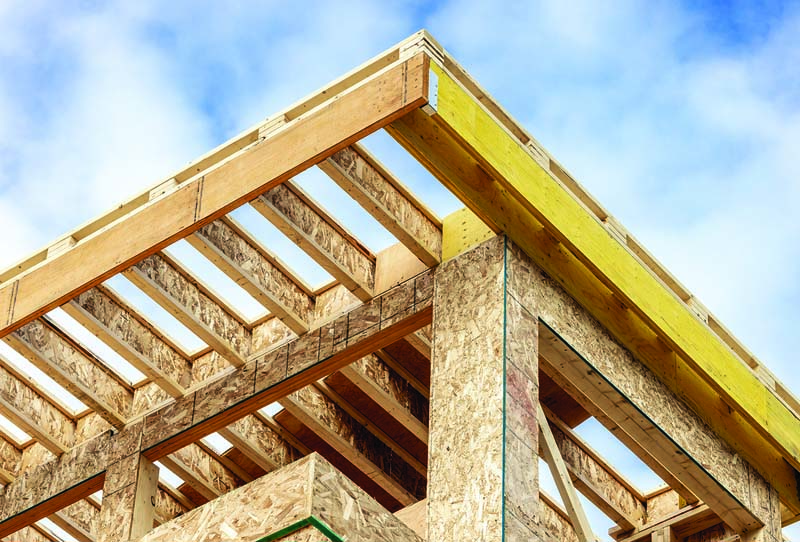
On every residential job site, engineered wood products define the structural landscape: Laminated Veneer Lumber (LVL) headers span wide garage openings, I-joists reliably carry floor loads across expansive clear spans, glulam columns anchor post-frame walls, and roof trusses are precisely spaced 24 inches on center from ridge to eave. These products form the backbone of rural and residential construction. As engineered wood technology also advances, it is incumbent upon builders to implement precise connection methodology.
Builders specializing in post-frame, stick-frame, or hybrid construction must demonstrate proficiency in engineered wood connections to achieve code compliance, maximize load strength, and ensure durability. This article provides authoritative guidance on essential products, hardware, and field practices that determine long-term performance.
Why Engineered Wood Changes the Connection Equation
Sawn lumber has historically served residential framing, allowing for established nailing, strapping, and bracing methods. Engineered wood introduces fundamentally distinct behaviors, necessitating specialized connection design and installation.
Laminated Veneer Lumber (LVL), Parallel Strand Lumber (PSL), Laminated Strand Lumber (LSL), and I-joists are manufactured under controlled factory conditions to deliver predictable, consistent performance. That predictability is a significant advantage — but it comes with precise tolerances. The thin OSB webs of I-joists, for example, require connectors specifically designed to carry load at the flange, not at the web. Attempting to hang an I-joist with hardware designed for solid dimensional lumber can result in web crushing, compromising the structural integrity of the entire floor system. Glulam beams and multi-ply LVL members require connectors rated for their actual design loads, not approximations borrowed from sawn lumber tables.
The proliferation of engineered wood in barndominiums, hybrid homes, and rural residences demands new connection requirements. Contractors must precisely match standards and hardware to the engineered wood’s unique demands.
The Connector Landscape: What Builders Should Know
Modern structural connector systems for engineered wood are essential for a range of applications, from lightweight joist hangers to high-capacity moment connections. Employing rated and tested hardware is imperative for sound construction.
Joist and beam hangers are common in residential framing. Manufacturers offer I-joist connectors with top-flange or face-mount options, shaped for flange width and nailing zones. Glulam and LVL beams use heavy-duty seat hangers and knife plate connections to distribute loads more effectively.
“We are continuously researching and designing new wood construction connectors with the goal of bringing to market innovative products that improve performance, make installation easier and solve our customers’ building challenges. At the same time, we’re also investing in our software and apps to make it simpler for customers to find and specify the right products, faster and with greater confidence.”
— Scott Park, Simpson Strong-Tie Director of Product Development – Connectors, Lateral and Steel
Post bases and column caps are crucial in post-frame and hybrid construction. Columns support gravity and lateral loads, so connectors must fit post dimensions and design loads, including wind uplift—a significant factor in rural areas.
Hold-downs and tension ties create a continuous load path, transferring uplift and lateral forces from roof to foundation. Most jurisdictions require this, and its integrity depends on each connection from the roof to the anchor bolt.
Manufacturers now offer solutions for truss installation, replacing temporary wood bracing that increases labor costs and safety risks. Permanent steel bracing allows framers to set, space, and brace trusses in one step, reducing the need for wood blocks and streamlining roof installation.
“It’s important to understand that lateral restraints alone are not adequate to resist buckling in a roof truss system.”
— Charles Emma, Product Manager, FastenMaster From Foundation to Ridge: The Continuous Load Path
The continuous load path is essential yet often misunderstood in residential structural design. Every vertical and lateral force must be transferred, connection by connection, from origin to ground. A well-engineered roof assembly not tied to wall framing or a poorly anchored wall sill plate creates vulnerabilities.
In residential buildings with engineered wood framing, the load path includes every connector. Truss tiedowns and rafter anchors transfer wind uplift to the top plate, shear wall panels and straps carry lateral forces through wall studs, and hold-downs anchor walls to the foundation against wind and seismic forces. Each connection must be specified for actual design loads, not chosen by routine.
Load-path analysis is essential for rural builders in high-wind areas. Barndominiums and rural homes often face wind loads above suburban code minimums. Builders and engineers rely on manufacturer load tables and software to ensure connectors meet site-specific conditions.
Corrosion, Coatings, and the Rural Environment
Rural sites face greater corrosion risks due to agricultural chemicals, fertilizer dust, manure gases, and treated lumber, especially copper-based preservatives. Connectors suitable for standard residential use may fail in pole barns, rural homes near livestock, or buildings with pressure-treated framing.
Modern connector systems address this through a range of protective coatings calibrated to the exposure level. Hot-dip galvanizing provides a robust zinc coating suitable for most exterior applications and contact with preservative-treated lumber. ZMAX® coatings offer enhanced protection in environments with elevated chemical exposure. Stainless steel connectors are available for the most severe environments, including coastal applications where salt air compounds the corrosion risk.
Builders must identify the exposure category before design and select connectors accordingly. Rural residential builders should formalize material standards for exposure levels and integrate them into estimating and ordering.
Installation: Where Design IntentMeets Field Reality
Installation errors undermine even the best-engineered connector systems. Typical mistakes—using incorrect or insufficient fasteners, improper placement outside nailing zones, and misorientation—result in significant reductions in rated capacity.
Connector manufacturers provide installation instructions specifying fastener requirements, edge distances, and nailing zones. Published load values are based on lab testing; incorrect fasteners or quantities reduce performance.
Pre-drilling requirements for engineered wood differ from those for sawn lumber. LVLs and PSLs, due to higher density, make end-grain fastening difficult. I-joists require precise fastener placement to avoid web damage. Engineered fasteners, like screws that eliminate pre-drilling, enhance speed and accuracy.
“At FastenMaster we’re dedicated to developing and delivering products that increase productivity and safety on the jobsite. Our products help PROs get the job done faster and safer.”
— FastenMaster Product Team
Code Compliance and the Role of Tested Systems
The 2024 International Residential Code and Wood Frame Construction Manual set baseline requirements for residential wood-frame construction, including connection needs for wind and seismic design. In many jurisdictions, these are enforced through permits and inspections, with inspectors verifying proper installation of connectors.
ICC-ES evaluation reports — independent third-party assessments of connector products against the applicable code provisions — are the standard mechanism by which manufacturers demonstrate code compliance for their products. These reports specify the conditions under which published load values apply, including fastener type, installation configuration, and lumber species group. Builders who specify connectors using ICC-ES reports can be confident that the products they are using have been evaluated against current code requirements.
Building officials can accept or reject products and installations. Builder familiarity with connector specifications provides a practical advantage. Knowing the code compliance basis for connection decisions and providing documentation when needed streamlines inspections and reduces risk.
Planning Ahead: Specification and Ordering
One of the most practical recommendations for builders working with engineered wood connections is to integrate connector specification into the project planning phase rather than treating it as a field decision. Engineered wood manufacturers — including truss fabricators, LVL suppliers, and glulam producers — typically provide connection details as part of their component documentation. Reviewing those details in advance, confirming that the required connectors are available through local distribution channels, and ordering them with the framing package eliminates last-minute substitutions that may not be equivalent.
Connector manufacturers provide software tools and web applications for product selection, load verification, and code-compliance documentation. These tools reduce the builder’s design burden and ensure specifications are based on engineering data. For complex projects, early consultation with a structural engineer can identify connection requirements that may not be evident in framing drawings.
Connectors are a small portion of the project cost but greatly impact structural outcomes. Investing in proper specification, sourcing, and installation in accordance with manufacturer requirements is crucial for structural integrity and business reputation.
Mass Timber and EvolvingConnection Technology
At the leading edge of engineered wood construction, mass timber products, including cross-laminated timber (CLT) panels and large-section glulam members, are beginning to appear in rural residential and mixed-use projects. These materials bring new connection challenges, including the need for concealed connectors that preserve the visual appearance of exposed timber surfaces while delivering high structural capacity.
“The growing use of mass timber in premium rural residential and hybrid projects is driving demand for high-capacity concealed connectors that maintain the beauty of exposed timber while delivering the structural performance builders need. Innovations like aluminum concealed beam hangers and glued-in rod systems are making these materials more accessible and installer-friendly, helping contractors capture higher-value work without compromising on speed,
safety, or code compliance.”
— Michael Weinert, Senior Product Manager, Mass Timber and Offsite Construction, Simpson Strong-Tie
Concealed beam hangers, glued-in rod connections, and specialized plate hardware for large timber sections are expanding product categories. Familiarity with mass timber connection principles and manufacturers positions builders to access the premium rural residential market.
KEY TAKEAWAYS FOR BUILDERS
Match connector specifications to the specific engineered wood product being used — I-joist hangers, LVL connectors, and glulam hardware are not interchangeable.
Design the continuous load path from roof to foundation before framing begins, and specify every connector in that path based on actual design loads.
Select connector coatings for the actual exposure environment, including proximity to treated lumber and agricultural chemical exposure.
Follow manufacturer installation instructions precisely, including fastener type, quantity, and placement — these specifications are the basis for published load values.
Use ICC-ES evaluation reports and manufacturer software tools to support code compliance documentation.
Integrate connector specification into the pre-framing planning process and order with the framing package.
MANUFACTURER TECHNICAL RESOURCES
• Simpson Strong-Tie — strongtie.com.
• MiTek Residential Construction Industry — mitek-us.com
• FastenMaster (OMG, Inc.) — fastenmaster.com
Resources & SOURCES INDUSTRY ORGANIZATIONS
• APA — The Engineered Wood Association: apawood.org | Technical resources, design guides, webinars,and wall bracing calculator for IRC compliance.
• American Wood Council (AWC): awc.org | Wood Frame Construction Manual (WFCM) 2024, design guides, and free online resources.
• Structural Building Components Association (SBCA): sbcacomponents.com | Resources for truss fabricators and builders on component design and installation.