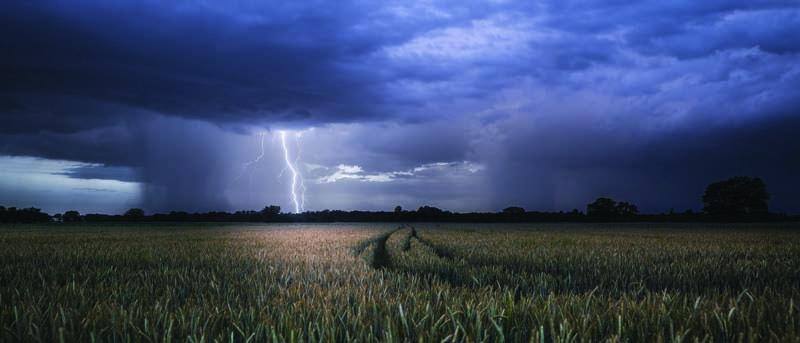
Originally Published as: When Lightning Strikes: A Builder’s Guide to Lightning Protection for Agricultural Structures: Post-frame and metal building contractors have both the opportunity and responsibility to protect clients’ farms, livestock, and livelihoods from one of rural construction’s most costly and preventable threats.
Each spring and summer, storms across America’s agricultural regions often result in lightning striking the tallest object in a field, causing barns and their contents to catch fire. At best, farmers file insurance claims and rebuild. At worst, they lose livestock, equipment, and potentially the viability of their entire operation.
For rural builders, particularly in post-frame and metal construction, lightning protection is essential. It is as fundamental as proper drainage or structural calculations, yet it remains one of the most overlooked and misunderstood aspects of agricultural construction.
This article offers a practical overview of lightning protection for agricultural structures, including the science, standards, systems, and how builders can make it a standard part of every project discussion.
The Real Cost of a Lightning Strike
Lightning is the leading cause of farm fires in the United States, according to the National Board of Fire Underwriters. It accounts for more than 80 percent of all livestock losses attributable to accidents and causes millions of dollars in damage to farm buildings and equipment each year. A single strike can kill an entire pen of cattle, destroy a season’s worth of stored hay, ignite a grain bin, or knock out the electrical and ventilation systems that keep modern poultry and hog operations running.
Losses often extend beyond the initial impact. Modern farms rely on sensitive electronics such as automated feeding systems, climate controllers, milking machinery, GPS equipment, and security cameras. A direct or nearby lightning strike can cause power surges that damage circuit boards, disable HVAC and ventilation systems, and leave critical infrastructure inoperable for extended periods. Each day of downtime results in lost income and increased labor costs.
Four-legged animals are especially vulnerable to ground current, the electrical charge that spreads from where lightning enters the soil. Cattle and horses, with all four legs on the ground, experience a greater voltage difference than humans, making “step potential” potentially lethal to groups of animals, even if the strike occurs at a distance.
“Every farm structure we build represents a significant investment in someone’s livelihood. When we talk about lightning protection with our clients, we’re not upselling — we’re protecting the asset they just paid us to build. A properly installed system is a fraction of the replacement cost of a single lost animal, let alone an entire structure.”
— McElroy Metal, Agricultural Post-Frame Building Specialist
Understanding How Lightning Protection Systems Work
A lightning protection system (LPS) does not prevent strikes but intercepts them and provides a controlled, low-resistance path for the electrical charge to reach the ground safely, bypassing flammable materials, electronics, and living beings.
A complete, code-compliant system has five core components:
Air Terminals (Strike Termination Devices): Formerly known as lightning rods, these are mounted at the highest points of the structure, such as ridgelines and peaks, to intercept strikes before they reach non-conductive materials. They must be at least 10 inches tall and spaced no more than 20 to 25 feet apart along the ridgeline.
Conductor Cables: Multi-strand copper or aluminum cables connect the air terminals and safely guide lightning current down and around the structure. These conductors must be continuous, properly sized, and routed without sharp bends to prevent arcing.
Grounding Electrode System: Ground rods, typically copper-clad steel, must extend at least 10 feet vertically into the earth and be spaced according to soil and site conditions. Ground rings may be needed for larger structures. The goal is to efficiently dissipate the charge into the earth.
Bonding: All metallic elements of the building, including roof panels, structural steel, gutters, water lines, HVAC components, and connected fences, must be electrically bonded to the LPS. Unbonded metal can create dangerous side-flash hazards where lightning arcs between systems with different electrical potentials.
Surge Protective Devices (SPDs): Installed at every electrical, communications, and data service entrance, SPDs prevent surges from traveling along utility lines. They are a critical but often overlooked component of a complete system.
The Lightning Protection Institute puts it plainly: lightning protection systems are designed first and foremost as fire protection systems. The entire architecture of the system exists to prevent a building from burning down and to protect the people and animals inside.
The Metal Building Question: Does a Metal Roof Attract Lightning?
A common misconception in agricultural construction is that metal roofs increase the risk of lightning strikes. This is incorrect, and contractors should address this myth to properly inform their clients.
Lightning is attracted to height and atmospheric conductivity, not the roof’s material. A metal-roofed barn is no more likely to be struck than a wood-framed structure of similar height and location. The key factor is how the energy is managed after a strike.
The Metal Construction Association (MCA) addresses this in its Lightning Best Practices Guide. According to MCA, metallic siding and metal roof panels provide mechanical weathertightness but are not designed for safe electrical continuity during lightning events. While a metal roof conducts charge, it lacks the controlled pathways needed to safely direct the energy to ground. Without a properly installed LPS, a strike can still cause fire, structural damage, and equipment failure.
When a metal roof is properly grounded in accordance with NFPA 780, it offers significant advantages. The conductive surface disperses charge over a wider area, reducing localized heat and fire risk compared to non-conductive materials. A well-grounded metal building is more resilient during storms, provided electrical continuity is properly managed.
“The question isn’t whether the metal roof will conduct a strike — it will. The question is whether it’s connected to a system that knows what to do with that energy. A complete lightning protection system turns a potential catastrophe into a non-event. Without one, even a metal building is vulnerable.”
— Perma-Column LLC, Agricultural Post-Frame Foundation Systems
Codes and Standards Every Builder Must Know
Lightning protection for agricultural buildings is governed by multiple codes and standards. Builders who understand these requirements are better equipped to specify, subcontract, or coordinate LPS work effectively.
NFPA 780 — Standard for the Installation of Lightning Protection Systems
Published by the National Fire Protection Association, NFPA 780 is the primary national standard governing the design and installation of lightning protection systems in the United States. Originally adopted in 1904 under a predecessor name, it has been continuously refined and is now in its most current edition. NFPA 780 specifies air terminal placement and spacing, conductor sizing and routing, ground rod depth and configuration, bonding requirements for metallic systems, surge protection installation, and special applications including agricultural buildings.
NFPA 780 also includes a risk assessment framework that enables builders and owners to calculate the probability and consequences of a lightning strike for a specific structure. This online tool provides a data-driven basis for recommending a full LPS installation.
UL 96A — Installation Requirements for Lightning Protection Systems
UL 96A, published by Underwriters Laboratories, sets component and installation requirements for systems eligible for a UL Master Label or Lightning Protection Inspection Certificate. When an LPS meets UL 96A and is inspected by a UL-authorized inspector, the owner receives documentation of compliance. This certification is increasingly valued by insurers and may support premium reductions.
LPI-175 — Lightning Protection Institute Standard of Practice
The Lightning Protection Institute publishes LPI-175, a standard for LPS design, installation, and inspection. It also offers an inspection program (LPI-IP) that allows certified master installers/designers (MIDs) to inspect and certify systems. Specifying an LPI-certified installer ensures lightning protection work meets national standards.
NFPA 70 — National Electrical Code
The NEC governs the building’s electrical grounding system, requiring all grounding electrode systems, including the LPS, electrical service, communications, and antenna grounds, to be bonded together. This interconnection is critical for agricultural structures, where multiple grounding systems are common. Isolated, unbonded systems can create voltage differences that cause dangerous side-flash during a strike.
Special Considerations for Agricultural Buildings
Agricultural structures present unique lightning protection challenges that differ significantly from those in commercial or residential projects. Builders must understand these conditions before recommending or coordinating a system.
Livestock Shelters and Barns
Livestock shelters require LPS installations that account for grounding electrode placement relative to the areas where animals congregate. Ground rods must be positioned and sealed to minimize step potential hazards. All metal watering systems, stanchions, and gates must be bonded into the system. In hay storage structures, the fire risk from a direct strike is acute — dry hay ignites readily, and a barn fire can spread faster than emergency services can respond in rural areas.
Grain Storage and Handling Facilities
Grain bins, elevators, and storage structures are tall, isolated, and filled with combustible material. They represent some of the highest-risk agricultural structures from a lightning standpoint. Augers, conveyors, and other handling equipment must be bonded to the LPS. These structures should also have surge protection on all electrical feeds, including power and data lines running to monitoring and control systems.
Poultry and Swine Confinement Buildings
Modern confinement buildings are heavily wired, temperature-sensitive environments where a power failure or surge can quickly become a life-safety emergency for the animals inside. All electrical service entrances, including feed control systems, ventilation, and monitoring equipment, must be protected with properly rated SPDs. The fire risk from a direct strike in these structures is compounded by the litter and bedding materials used inside.
Post-Frame Foundations and the Grounding System
The foundation type used in post-frame construction has direct implications for the lightning protection grounding system. Traditional embedded wood posts offer limited pathways for integrating rebar or structural steel into the grounding network. Precast concrete column systems with steel reinforcement, by contrast, allow bonding to embedded steel and extending the grounding network below grade — a significant advantage for a complete system. Builders working with concrete column foundations should coordinate with the LPS installer early to ensure the groundwork is laid correctly before the concrete is poured.
“When we spec a permanent concrete column foundation, the structural integrity of the building improves from the ground up. That same foundation, when properly bonded, becomes a critical component of the lightning protection grounding system. It’s one of those cases where doing the job right the first time pays off in more ways than one.”
— MWI Components, Post-Frame Building Products Manufacturer
The Builder’s Role: What to Know and What to Coordinate
Lightning protection is a licensed specialty trade in many states. General contractors and post-frame builders are usually not the installers, but they are often the client’s primary point of contact. Their decisions in design, scheduling, and subcontracting significantly impact whether a building has effective lightning protection.
Builders should be aware of several key coordination points:
Plan early. LPS installers may be among the first trades on site to install ground rods during excavation and among the last to complete roof-level work. Lightning protection cannot be easily retrofitted after a metal roof is installed without risking roofing warranties and weathertightness. Include it in the project scope from the design phase.
Specify certified installers. The Lightning Protection Institute (LPI) and Underwriters Laboratories (UL) offer certification programs for LPS installers. An LPI-certified Master Installer/Designer should be specified for any project requiring lightning protection. Uncertified contractors often omit critical bonding connections and SPDs, resulting in non-compliant systems.
Coordinate with roofing. LPS air terminals must be mounted on or penetrate the metal roof, requiring coordination between the LPS installer and the metal panel manufacturer. This ensures mounting hardware and sealants are compatible with the panel system and do not void the roofing warranty. The 2024 International Building Code now includes specific requirements for this coordination.
Watch for dissimilar metals. LPS components must match the roof and building materials to prevent galvanic corrosion. Copper components should not contact aluminum or galvanized steel roofing. Use aluminum LPS components on steel or aluminum roofs, and use bimetallic connectors when splicing conductors of different metals.
Do not overlook fences. Wire fences connected to or near agricultural buildings must be grounded to prevent dangerous charges from reaching areas where livestock and workers are present. This is often missed on agricultural LPS projects.
Obtain third-party certification. At project completion, an LPI Inspection Program certificate or UL Lightning Protection Inspection Certificate verifies independent system compliance. This protects the building owner, supports insurance compliance, and safeguards the builder in the event of a post-strike claim.
The Business Case: Why Builders Should Lead This Conversation
Builders who consistently address lightning protection early develop a reputation for thoroughness, leading to referrals and long-term client relationships. Agricultural clients who lose a building to a preventable lightning strike, especially when protection was not discussed, rarely become repeat customers.
The cost of a complete, professionally installed lightning protection system for a typical agricultural post-frame building is modest compared to the overall project cost, usually a fraction of a percent of total construction value. Considering the potential costs of replacement, lost livestock, equipment damage, and downtime, the return on investment is clear.
Many farm owners qualify for insurance premium reductions or favorable claims treatment when a certified LPS is installed. Builders who guide clients through the NFPA 780 risk assessment and help them understand their specific exposure, including lightning frequency, building height, occupancy, and contents, provide value that extends beyond construction.
“We started treating lightning protection as a standard line item in our estimates — not an option. Once clients understand the exposure they’re carrying, the question is never whether to install it. It’s who handles it and when.
Having that conversation early, before the project breaks ground, is what separates a complete builder
from someone who just puts up walls.”
— Plyco Corporation, Manufacturer of Agricultural Building Components and Door Systems
Conclusion: Build It Right — All the Way Down to the Ground
Post-frame and metal building contractors play a vital role in American agricultural construction. Their clients, including farmers, ranchers, and rural landowners, rely on these structures to protect animals, equipment, and livelihoods.
Lightning protection is not a specialty add-on or an insurance afterthought. It is a building system that requires planning, proper materials, licensed installation, and third-party verification. Builders who make lightning protection a standard part of every agricultural project deliver a higher level of service to their clients.
In a business built on craftsmanship and trust, ensuring the building is complete from the air terminal to the ground rod is an essential part of the job.
Resources & Sources
Industry Standards & Codes
• National Fire Protection Association. www.nfpa.org
• Underwriters Laboratories. www.ul.com
• Lightning Protection Institute. www.lightning.org
Technical Publications & Guides
• Metal Construction Association www.metalconstruction.org
• Lightning Protection Institute: www.lightning.org
• East Coast Lightning Equipment, Inc. (ECLE): www.ecle.biz
• Chamberlain, Diane and Hallman, Eric: “Lightning
Protection for Farms.” Cornell Agricultural Health & Safety
Program / USDA Cooperative Extension. Cornell University.
Industry & Agricultural Data Sources
• Wisconsin Public Service: Farm Lightning Protection
agricultural resource guide. www.wisconsinpublicservice.com
• Vaisala NLDN (National Lightning Detection Network)
www.vaisala.com
• McElroy Metal www.mcelroymetal.com
• Perma-Column LLC www.permacolumn.com
• MWI Components www.mwicomponents.com
• Plyco Corporation www.plyco.com