During windy conditions, large commercial doors, such as hydraulic and bifold doors, are subjected to significant stress. But with a wind-resistant design, they can withstand the elements and provide years of reliable service.
While hydraulic and bifold doors have similar functions, and both are constructed of structural steel tubing, they operate differently. Hydraulic doors use pistons to raise a single panel door, hinged at the top, that swings out and up in a large arc. A bifold door, on the other hand, uses two panels hinged at the center that are raised using cables or straps.
Hydraulic and bifold doors are good options for larger openings. “When an opening exceeds 30 feet in width, they’re generally more practical than sliding doors,” said Jason Myrvik, president of Midland Door Solutions. With the increasing size of agricultural and commercial buildings, they are becoming more popular.
“The amount of wind-resistance a door provides depends on how the door is engineered, reinforced, and tested to meet building codes,” Myrvik explained. “Doors are engineered to meet local building codes, but not all doors are provided with stamped engineering drawings.” Stamped engineered drawings can be provided at an additional cost, however.
The engineering approval is done at the state level to meet the local codes. “Your door design can be approved and sealed by a professional engineer registered in the state where the project is located for the proper wind loading and exposure,” according to Schweiss Doors, a manufacturer of both hydraulic and bifold doors.
According to Zach Campbell, Lead Engineer at PowerLift Hydraulic Doors, “Single-panel hydraulic doors, especially fully welded steel doors, are extremely robust. A well-engineered single-panel hydraulic door should be designed to be open in winds up to at least 40 mph. The hydraulic cylinders, frame, and door leaf on these doors form a strong rigid triangle to hold the door firmly in position when open, even in windy conditions. There is no slack in the door system which would allow the door to bounce in the wind.”
Overhead Door Wind-Resistance Building Codes and Testing Standards
The core building codes and testing standards that apply to overhead doors for wind resistance, such as the International Building Code (IBC), ASCE 7, and DASMA’s testing standards (ANSI/DASMA 108 and 115), are the same frameworks used for both hydraulic and bifold doors.
Wind-resistance testing is performed as a complete system, rather than just testing individual components separately. For example, when hydraulic and bifold doors incorporate windows, they aren’t considered a weak area in the door. The window components are part of the overall door system that has been rigorously tested to industry wind load standards.
The Importance of the Building Structure for Door Support
All large commercial doors, including hydraulic and bifold doors, rely significantly on the surrounding building structure for their primary support and wind resistance. “Whether a building is constructed from wood or steel, it needs to be engineered to support the forces of wind being applied to the door structure,” Myrvik said. “The door manufacturer should provide loading information to the building manufacturer to ensure the jambs and header are sized adequately to handle the forces.”
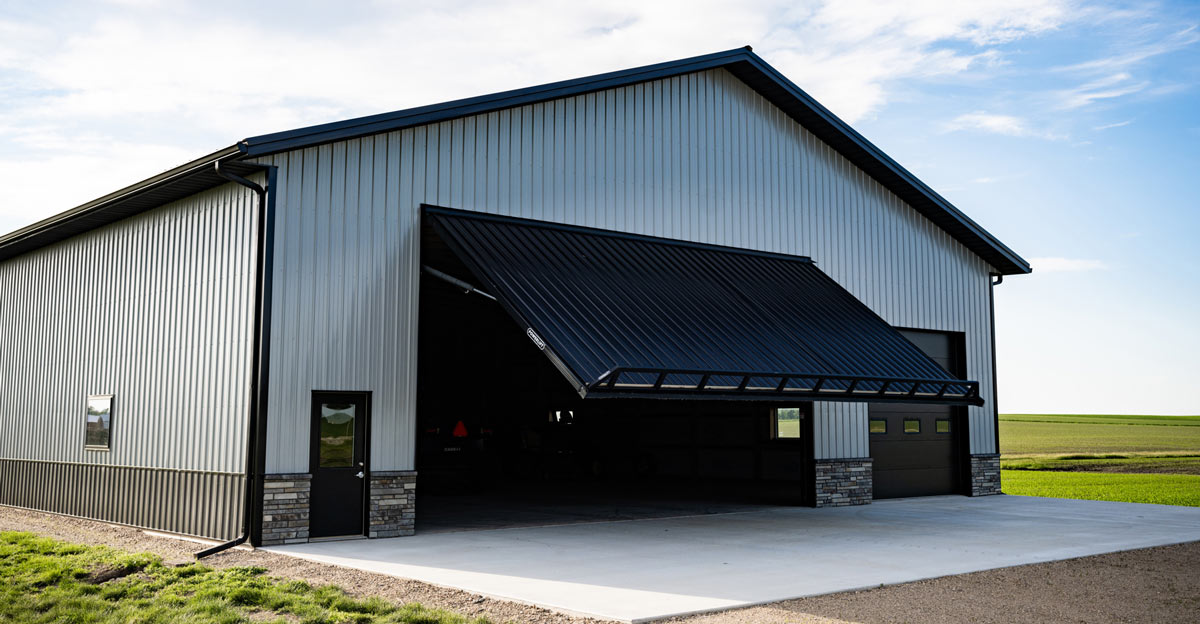
(Left) The hydraulic cylinders, frame, and door leaf on this PowerLift door form a strong rigid triangle to hold the door firmly in position when open, even in windy conditions. Photo courtesy of PowerLift
Hydraulic Doors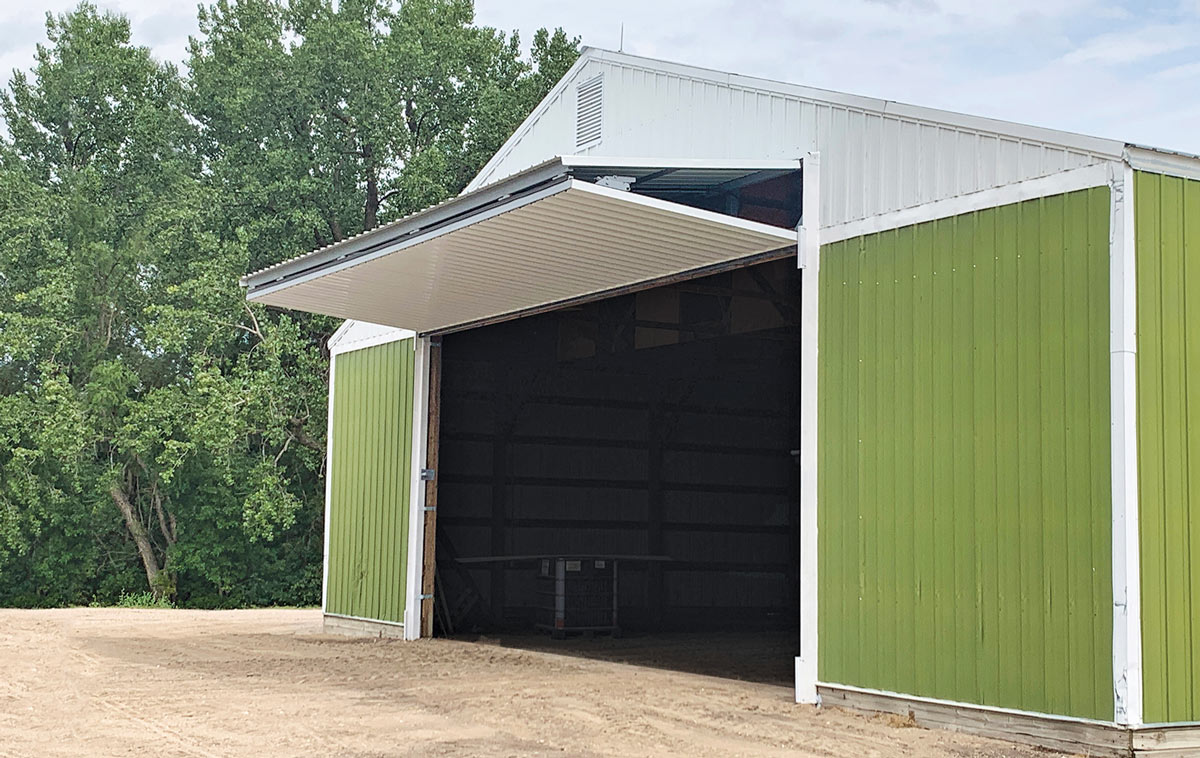
Hydraulic and bifold doors are good options for larger openings. When an opening exceeds 30 feet in width, they’re generally more practical than sliding doors” according to Jason Myrvik, president of Midland Door Solutions. With the increasing size of agricultural and commercial buildings, they’re becoming more popular.
Photo courtesy of Midland Door Solutions
Handling Positive and Negative Wind Pressures
“Single-panel hydraulic doors can be designed to withstand both positive and negative wind pressures exceeding 200 mph, even on extremely large doors exceeding 100’ in width and 28’ in height,” said Campbell. “This is accomplished through steel tube sizing and general structural design along with removable steel wind pins. These steel wind pins, often called ‘hurricane pins,’ are inserted through a welded steel bracket on the bottom of the door into the concrete floor when extreme winds are expected.
“Under normal conditions (winds 40 mph or less) wind pins are not necessary. The hydraulic door is locked closed by hydraulic pressure built up in the cylinders,” Campbell added. “When the door is closed, it is normal for the door operator to continue activating the ‘close’ button for two to three seconds after the door leaf is tightly closed against the frame. This builds hydraulic relief pressure in the rod end of each hydraulic cylinder, usually to about 2,500 psi. This effectively locks the door closed with several thousand pounds of hydraulic force, which is enough to withstand significant wind loads without being pulled open. Combined with one or more steel wind pins across the bottom of the door, single-panel hydraulic doors can be designed to withstand any wind speed on earth.
“Positive wind pressures are easy to design for as long as the door comes with its own stationary frame that attaches to the building,” Campbell explained. “This significantly strengthens the building opening by adding additional structure and giving extra support against wind trying to blow the door in. Removable steel wind pins can help with extreme positive wind pressures just as they do with extreme negative wind pressures.”
Door Limitations and Precautions
While wind-resistant hydraulic and bifold doors can deal with windy conditions, precautions need to be taken to ensure they aren’t overstressed. They’re designed to handle the wind in a closed and latched position. “It is imperative that either door type be closed and locked during a high-wind event to prevent damage to the door or building structure,” Myrvik said. “We recommend the door in the closed and latched position in any wind speeds greater than 30 mph.”
Site Considerations for New Building Construction
Building orientation and prevailing wind direction should be a consideration during site planning, especially for structures featuring large hydraulic or bifold doors. While Midland’s doors are rigorously designed for specific wind loads regardless of direction, strategic placement can help mitigate the most extreme wind forces on the overall building. This integrated approach not only optimizes the entire structure’s wind performance but can also enhance the door’s long-term operability.
Replacing a Sliding Door with a Hydraulic or Bifold Door
A structure designed for a sliding door will need to be modified to accommodate a hydraulic or bifold door. “Structural framing, and potentially concrete footings, will need to be added to allow the door to be properly secured to the building structure, although the new door typically comes with a support structure,” Myrvik said. “The support structure needs to be anchored to the building for lateral support. Therefore, it requires additional reinforcement.”
Conclusion
Wind-resistant hydraulic and bifold doors create an efficient and effective building access system, especially for large openings and in areas prone to high winds. However, builders should ensure that both new buildings and refitting projects have adequate structural support for the doors. In addition, for new construction in wind-prone areas, building orientation and prevailing wind direction should be taken into consideration to help reduce potential strain on the doors.
The Relationship Between Wind-Resistance Building Codes and Geographic Location
By Jason Myrvik, Midland Door Solutions
Wind resistance codes are tied to geographic location because of varying wind risks across the country. The higher the likelihood of severe winds, tornadoes, or hurricanes in a specific area, the stricter the building codes for wind resistance becomes. Wind speeds and other factors are used to determine design wind pressures for testing and assessing doors. Risk categories and exposure categories are the classifications used to assess the potential risk and exposure of a building to wind hazards. The International Building Code (IBC) defines these below:
Risk Category
Category I: Buildings and structures that represent a low risk to human life and health in the event of failure. This category includes agricultural buildings, minor storage facilities and other structures with low occupancy loads.
Category II: Buildings and structures that represent a moderate risk to human life and health in the event of failure. This category includes most commercial and residential buildings, such as offices, retail stores, apartments, and hotels.
Category III: Buildings and structures that represent a substantial risk to human life and health in the event of failure. This category includes buildings with high occupancy loads or buildings essential to public safety, such as hospitals, schools, and high-rise buildings.
Category IV: Buildings and structures that represent an essential risk to human life and health in the event of failure. This category includes buildings housing hazardous materials, emergency response facilities and critical infrastructure.
Exposure Category
Exposure B: Represents the least wind-exposed areas, such as urban or suburban areas with numerous buildings, trees or other obstructions that shield structures from the full force of the wind.
Exposure C: Areas with moderate wind exposure fall into this category. Applies to urban or suburban areas with some obstructions but less dense than Exposure B areas.
Exposure D: Applies to locations with significant exposure to wind, such as coastal areas or flat, open terrain without many obstructions.